
| Table of Contents |
| The Guangzhou Railway Station Clothing Market Area |
| Guangzhou Thirteen Hongs of Canton |
| The Shahe Clothing Market Area |
| 4 Specialized Clothing Markets |
| Sourcing Tips for Guangzhou Clothing Markets |
| Want Someone on the Ground? Here’s How We Help |
The first time I walked into the Guangzhou clothing market near the railway station, I lasted about forty minutes before I had to step outside and sit down. Thousands of stalls. Five, six, seven floors of them, stacked in towers that go on for blocks. Sellers shouting prices. Carts of plastic-wrapped jackets rolling past your ankles.
It’s the biggest clothing wholesale hub on the planet, and if you don’t know the layout, it will eat your whole trip.
So let me save you the headache. There are really three main areas that matter, plus a handful of specialized markets worth a detour. Here’s how to read the map.
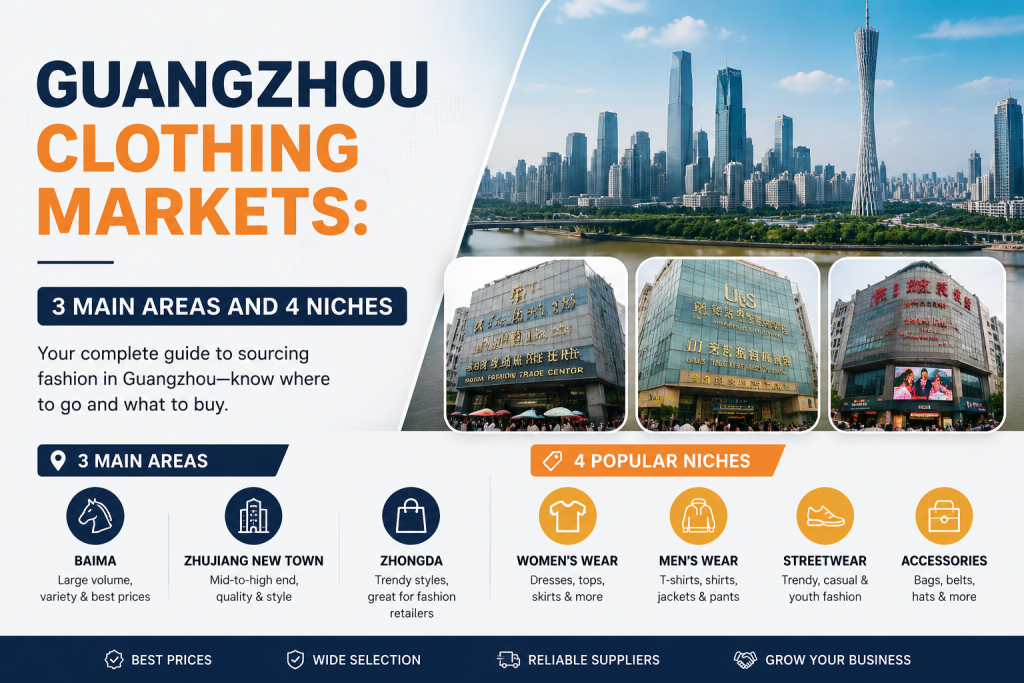
The Guangzhou Railway Station Clothing Market Area
Start here, because it’s the beast everyone’s heard about. The area around the Guangzhou Railway Station is the densest cluster of clothing wholesale buildings anywhere, and it’s where most first-timers begin.
The headliner is Baima (sometimes written Baimaa). It’s the most famous building in the whole district and leans toward mid-range to higher-quality women’s wear. A lot of the original-design and brand-style clothing in China passes through here. Prices are higher than the streets around it, but so is the quality, and the designs are fresher.
Right next door you’ve got buildings like Hongmian, Liuhua, and a dozen others, each with its own personality. Some skew cheap and fast. Some carry better fabric. The trick is that quality and price swing hard from one building to the next, even when they’re fifty feet apart.
One thing nobody tells you. This area is wholesale, full stop. Most stalls won’t even quote you for a single piece, and plenty have minimums of three to five units per style just to talk. Show up expecting retail and you’ll get the cold shoulder. This is where understanding MOQ before you go saves you a lot of awkward conversations.
Guangzhou Thirteen Hongs of Canton
If the railway station is where you go for quality, the Thirteen Hongs is where you go for cheap and fast. This is the spot.
The name goes back centuries to the old Canton trading houses, but today it means one thing to buyers: budget fashion at rock-bottom prices, churned out at insane speed. Trendy tops, dresses, and casual wear that follow whatever’s hot right now. Think fast-fashion knockoffs of runway looks, priced to move by the dozen.
The catch is exactly what you’d guess. Quality is hit or miss. Fabric can be thin, stitching can be rough, and sizing runs all over the place. You’re trading durability for price and trend speed.
That makes the Thirteen Hongs perfect for some buyers and a trap for others. If you’re selling ultra-cheap fast fashion where the customer expects to wear it a season and toss it, the margins here are hard to beat. If you’re building a brand that needs to last, keep walking. I’ve watched sellers fall for the prices here and then drown in returns because the goods didn’t match the photos. A few quality control checks before you commit will tell you fast whether a stall’s samples hold up.
The Shahe Clothing Market Area
Shahe is the cheapest of the three main areas, and it’s a different crowd entirely. This is where small domestic resellers, market vendors, and budget online sellers go to stock up by the bagful.
Prices here can be shockingly low. We’re talking a few dollars a piece for basic tops and casual wear. The volume moving through Shahe is enormous, and it runs on speed and razor-thin margins.
But you get what you pay for. Quality at the bottom end of Shahe is the lowest of any major Guangzhou clothing market, and a lot of what’s sold is meant for the domestic Chinese budget market, not export. Sizing, labeling, and packaging often aren’t built for overseas selling.
Here’s my honest take. Shahe is great if you know exactly what you’re doing and you’re buying simple, low-risk basics in bulk. For most international buyers, though, the slightly higher prices at the railway station buildings are worth it for the jump in quality and the better fit for export. Don’t let the cheapest sticker decide for you. The cheapest goods that don’t sell are the most expensive mistake you can make.
4 Specialized Clothing Markets
Beyond the big three, Guangzhou has pockets that specialize. If your product fits one of these, going straight to the niche beats hunting through general markets.
Children’s and baby clothing. Zhongshan Ba Road is the go-to for kids’ wear. Whole buildings dedicated to baby and children’s clothing, from newborn onesies to school-age fashion. Specialized fabric, specialized sizing, much better selection than you’ll find scattered through a general market.
Jeans and denim. Head to the Junfeng and Xintang areas for denim. Xintang in particular is often called the jeans capital of China, producing a huge slice of the world’s denim. If jeans are your product, this is non-negotiable.
Underwear and lingerie. There are dedicated buildings for intimates, with the fabric quality and discretion this category needs. Worth seeking out rather than picking through general women’s wear stalls.
Leather and outerwear. Jackets, coats, and leather goods cluster in their own buildings too, especially seasonal outerwear. Quality and price vary wildly, so this is a category where samples matter more than anywhere else.
The pattern across all four: specialized markets give you deeper selection, better category-specific quality, and sellers who actually know their product. When your line fits a niche, skip the generalist floors. This is the kind of legwork our global sourcing team does so clients don’t burn three days finding the right building.
Sourcing Tips for Guangzhou Clothing Markets
I’ve made every mistake in these markets so you don’t have to. A few hard-won rules.
Go early. Many wholesale buildings open around 9 or 10 a.m. and the best stalls get picked over fast. Some even close in the early afternoon. Treat it like a morning job.
Bring a translator or someone who speaks Mandarin or Cantonese. Most stall owners speak little English, and the good prices and real conversations happen in the local language. This single thing changes your whole trip.
Always check samples in person. Photos lie. Feel the fabric, check the stitching, pull on a seam. What looks great on a hanger can fall apart at home, and you won’t get a refund once it’s shipped overseas.
Negotiate, but be realistic. Prices have room, especially as your quantity climbs. Don’t expect miracles on small orders, though. Real leverage comes with volume, and knowing how to play that is the heart of supplier negotiation and cost optimization.
Sort out shipping and consolidation before you buy. Buying from twenty stalls means twenty piles of goods that someone has to gather, quality-check, repack, and ship. That logistics piece is where a lot of solo buyers come unglued. If you’re moving real volume, bulk sourcing from China handled by people on the ground saves you the chaos.
And budget for the hidden costs. Hiring an agent has a price, but so does flying yourself across the world, eating travel costs, and risking bad orders. If you’re weighing it, our breakdown of China sourcing agent cost lays out the real numbers.
Want Someone on the Ground? Here’s How We Help
Here’s the truth about the Guangzhou clothing market. You can absolutely fly in and figure it out yourself. Plenty of people do. But it costs you days, language barriers, and a real risk of going home with goods that don’t match your samples.
We’re already there. We know which buildings carry export-grade quality, which stalls flake, and how to consolidate orders from a dozen sellers into one clean shipment. Our procurement outsourcing service means you don’t have to book the flight at all. You tell us what you want, we walk the floors, vet the samples, and handle the back-and-forth. To see the kind of results we deliver, the numbers tell the story.
You can book a free call and tell us what you’re sourcing, or just reach out here with your product and quantity.
The Guangzhou markets reward the people who know the map. Now you’ve got it.