
Health products are not like other products. If a phone case is badly made, you get a refund request. If a blood pressure monitor reads wrong or a supplement has the wrong ingredient, someone can get hurt, and your brand takes the blame.
That is why health products sourcing Canton Fair medical devices needs a different mindset than sourcing homeware or gifts. You still compare price and quality, but you also check rules, paperwork, and proof. This guide shows how to do that at Phase 3, from supplements and wearables to factories, private label, and fake products.
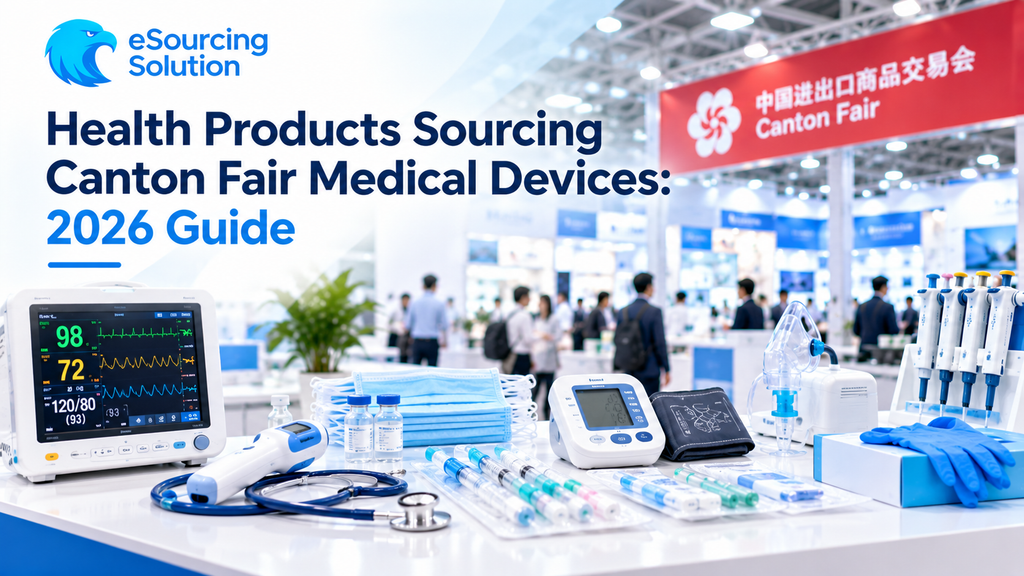
Table of Contents
What You Will Find at Canton Fair Phase 3
Phase 3 of the 140th Canton Fair runs from October 31 to November 4, 2026, at the Canton Fair Complex in Guangzhou. According to China’s Ministry of Commerce, the health side of this phase includes medicines, health products and medical devices, personal care and toiletries, and intelligent healthcare.
Read more about Canton Phase 3 here.
The same page says the fair’s website and app run all year and show the same sections as the on-site fair. So you can search exhibitors, filter by category, and contact suppliers before you fly.
Here is how we split the categories in this guide:
- Vitamins and nutritional supplements
- Health and wellness products
- Medical devices and diagnostics
- Wearable health technology
- Smart and connected care products
The Rules Come First
Before you look at a single product, find out what your market allows. Skipping this step is the most expensive mistake in this category.
In the US, medical devices go through the Food and Drug Administration (FDA). In China, the regulator is the National Medical Products Administration (NMPA). In the EU, devices need CE marking under EU rules. Each system has its own steps, so a product that is fine in one market can be blocked in another.
Three things usually matter most:
- Approval for your market. Does the product have the clearance or registration it needs where you plan to sell?
- Claims. What the box says matters as much as what is inside it. A product that claims to treat or cure a disease is held to a much higher standard than one that supports general wellness. Keep your marketing within what the evidence and the rules allow.
- Import paperwork. Commercial invoice, packing list, test reports, certificates and any registration numbers. Your customs broker will ask for them.
A good habit: ask the supplier for approval documents at the booth, then check them yourself with the regulator. A photo of a certificate on a phone is not proof.
Medical Device Sourcing and Compliance
Medical devices need the most care, so we will go step by step.
- Step 1: Know the class. The FDA sorts devices into three classes based on risk. Class I is the lowest risk and Class III is the highest. According to the FDA, Class I devices need general controls, Class II need general controls plus special controls, and Class III need general controls plus premarket approval. Most Class I devices are exempt from premarket notification, but many Class II devices need a 510(k). Classification depends on what the device is meant to do, so the supplier’s claims matter. Read the FDA page on how to classify your medical device.
- Step 2: Check who has to register. The FDA says foreign manufacturers must register their establishments and list their devices. Initial importers must register too, and they must have a physical address in the US with staff responsible for compliance. Details are on the FDA page about who must register and list. The FDA marks that page as last updated in 2018, so check the site for changes.
- Step 3: Ask about the quality system. A factory that makes medical devices should work under a quality management system. The standard most buyers look for is ISO 13485. Ask for the certificate and check the scope, the issue date, and the certifying body.
- Step 4: Ask for testing and evidence. Request test reports for safety and performance. For higher-risk devices, ask about clinical data. If the supplier can’t explain how accuracy was tested, treat that as a warning sign.
- Step 5: Ask about records. You want batch records, component records, and a way to trace each unit back to a production run. If there is ever a complaint, this is what saves you.
Wearable Health Technology
This is the fastest-moving part of the category, and the one where buyers get most excited. That is a good moment to slow down.
Phase 3 buyers will see fitness trackers, smartwatches, heart rate and blood pressure monitors, sleep trackers and more. The big question is always the same: is it a wellness gadget or a medical device? A step counter is simple. A blood pressure monitor that tells you something about your health is a different story, and the rules change.
When you talk to a supplier, ask these questions:
- Has the sensor been tested for accuracy, and can you see the report?
- What certificates does the device already hold for the markets you sell in?
- Which battery type does it use, and does it have transport and safety certificates?
- How does the app work, where is user data stored, and who owns it?
- Who writes the software updates, and for how long will they support the product?
Software is the part many buyers forget. Your customers will judge the device by the app, so ask to see it running on a real phone, not on a slide.
Supplements and Nutritional Products
Supplements are about trust. The customer can’t see what is inside the capsule, so your paperwork has to do that job.
Start with ingredients. Ask where each raw material comes from and who the supplier is. Ask for a certificate of analysis for each batch, which should show potency, purity and tests for contamination such as heavy metals and microbes. A good manufacturer will give you this without a long fight.
Next, look at the label. Every market has its own rules for ingredient lists, nutrition or supplement facts, serving sizes, warnings, and the name of the responsible company. A label that is fine in China may not be fine in the US or the EU. Have your own regulatory person review the label before printing, not after.
Then look at the factory itself. Ask about good manufacturing practice (GMP) certification and about audits. Ask how they keep batches separate and how they track every ingredient from delivery to the finished bottle.
Last, ask about traceability. If one batch has a problem, can they tell you which raw material lots went in and which orders received it? If not, that is a risk you will carry.
Wellness and Personal Care Products
This group is wide, so here is a quick view of what to check in each type.
| Product type | What to check |
| Skincare and beauty | Full ingredient list, safety testing, shelf life, labeling rules in your market |
| CBD and hemp products | Local legal status first, then lab results for content and contaminants |
| Sleep aids and relaxation | Ingredient safety, claims on the box, any electrical safety marks if the item is a device |
| Personal hygiene | Material safety, skin testing, packaging and hygiene control in the factory |
| Natural and organic items | Certificates that match the exact product, not just the brand |
CBD needs a special warning. The rules for CBD and hemp products change a lot from country to country, and in some places from state to state. Check the law in your own market before you talk price with a supplier. If the answer is unclear, speak to a legal adviser first.
For natural and organic claims, ask for the certificate, the certifying body, and the products it covers. “Natural” on a label often means very little unless there is paperwork behind it.
How to Assess a Factory for Health Products
A clean booth and a good brochure tell you very little. Here are the checks that matter.
- GMP certification. Ask for it, check that it is current, and check that it covers the product you want. Some factories hold GMP for one line and not for others.
- Quality control and testing. Ask what they test in-house and what they send to outside labs. Find out how often, and what happens to a batch that fails.
- Ingredient sourcing and openness. A supplier who will not tell you where the ingredients come from, or who changes sources without telling you, is a risk.
- Traceability and records. Ask to see sample batch records. If they say these are secret, move on.
- Reputation and references. Ask who else they supply and whether you can speak to them. Where it makes sense, arrange an audit or a third-party inspection. Our quality control service covers this step.
Customization and Private Label
Private label is where many health brands make their margin, and Canton Fair lets you talk to many makers in a short time.
Here are the main things to talk about at the booth:
- Custom formulas and blends. Ask if the factory has its own formulation team and what the minimum order is for a custom blend.
- Branded packaging and labels. Bottles, boxes, pouches, inserts and labels. Check the lead times for printed materials, because they often decide your launch date. Our packaging optimization service can help here.
- Dose and format options. Capsules, tablets, powders, gummies or liquids. Each has its own cost, shelf life, and customer appeal.
- Exclusive products. If you want a product no one else sells, say so early and put it in writing.
- Bundles. Pairing items, like a monitor with a cuff or a supplement with a shaker bottle, can lift your average order value.
If you are still shaping the idea, our product idea development team can help you plan it before you meet suppliers.
Supply Chain Security and Anti-Counterfeiting
Fake health products are a real problem, and they can hurt your customers and your reputation.
Some quick lines on what to do:
- Test the ingredients, not just the finished product.
- Use packaging that is hard to copy, like tamper-evident seals, special inks or holograms.
- Put a serial number or batch code on every unit, so you can trace it.
- Keep copies of every certificate and test report, and match them to the batch you receive.
- Check quality at every step, from raw material to the container leaving the port.
- Protect your brand name and logo with a registration in your market. Our trademark and patent registration team can guide you, and our supply chain intelligence service can help you spot weak points before they cost you money.
Conclusion
Health products sourcing Canton Fair medical devices works best when you start with rules and proof, then move to price and style. Know the approval your market needs, ask for certificates early, check the factory behind the booth, and plan for traceability and anti-counterfeiting from the first order. Do this, and the exciting parts, like new wearables or your own private label range, become much safer to build.
Our team will be available during Phase 3 to help you navigate the health and medical products showcase, verify regulatory compliance (FDA, NMPA, CE marking), assess manufacturing quality, and source wellness products with confidence.
Ready to source with confidence? Book your free Phase 3 health products consultation with eSourcingSolution today.
Frequently Asked Questions
What health products are at Phase 3?
According to the official introduction, Phase 3 includes medicines, health products and medical devices, personal care and toiletries, and intelligent healthcare.
How does the FDA classify medical devices?
The FDA uses three classes based on risk. Class I is lowest risk, and Class III is highest. Most Class I devices are exempt from premarket notification, many Class II devices need a 510(k), and Class III devices usually need premarket approval.
Does a foreign medical device maker need to register with the FDA?
The FDA says foreign manufacturers must register and list their devices, and initial importers must register as well. Check the current rules on the FDA site, because they can change.
Can I sell CBD products?
It depends on your market. The rules differ a lot by country and sometimes by state. Check local law before you place an order, and ask a legal adviser if the rules are unclear.
How can I avoid counterfeit health products?
Test ingredients, use tamper-evident packaging, add serial numbers or batch codes, keep all certificates, and check quality at each step of the supply chain.