
You found a supplier. The photos look sharp, the price is lower than anyone else’s, and the sales rep replies within minutes. So far so good. But here is the question that decides whether this order makes you money or costs you money: is this company really what it says it is?
Knowing how to vet a Chinese manufacturer is one of the most useful skills you can have as a business owner who imports. In this guide, I’ll walk you through a 12-point checklist you can use before you send a single dollar. Some steps take ten minutes at your desk. Others need a video call or someone on the ground. All of them are cheaper than one bad shipment.
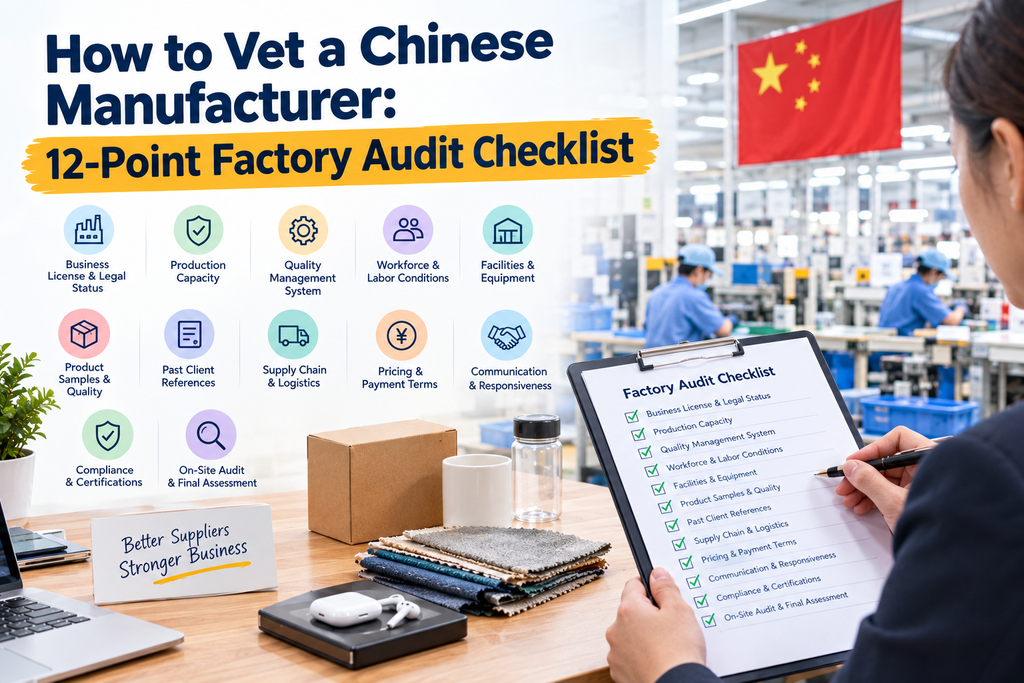
How to Vet a Chinese Manufacturer and Why It Matters
China is still where most of the world’s products get made. It produced around 30 percent of global manufacturing value added in 2025, and it has held the top spot for 16 years in a row. China contributed around 30 percent of global manufacturing value added in 2025, the largest in the world for 16 consecutive years. That is a huge pool of suppliers, which is good news, but it also means a lot of noise.
Here is the part nobody likes to say out loud. A team that has run more than 5,000 factory audits in Guangzhou reports that about one in three factories does not match what its online profile promised. Most of those are not scammers. They exaggerate. They say 5,000 square meters when it is 1,500. They list machines they do not own. And exaggeration in manufacturing means late, wrong, or missing orders for you.
Another industry guide makes the same point in simpler words: most sourcing problems, like quality failures, lost deposits, and goods that do not match the sample, start with skipped checks at the beginning. So let’s do the checks.
Verification vs. Audit: Know the Difference
Many owners mix these up, so let me clear it up.
- Verification answers one question: is this company real? You check the licence, the registration, and the paperwork.
- A factory audit answers a harder one: can this company actually deliver? You look at machines, people, quality control, and materials.
Think of a restaurant. Verification is checking it has a health permit. An audit is walking into the kitchen. You need both, and the order matters. Paper checks first, then the audit.
Part One: The Paper Checks (Points 1 to 6)
1. Check the business licence
Every legal Chinese company has a business licence with an 18-character Unified Social Credit Code. Ask for a copy. Then check the company name, address, registered capital, and the business scope. The scope should include manufacturing for your product type. If it only says “trading,” you are talking to a middleman.
2. Match the name to the bank account
The name on the licence, the contract, and the bank account should all be the same. If someone asks you to pay a personal account or a different company, stop. This is one of the most common scam patterns, and it is easy to avoid.
3. Work out if they are a factory or a trader
Ask plain questions. How many production lines do you have? What is your monthly capacity? Can you show me the workshop on a live video call right now? A real factory answers fast. A trader dodges, changes the subject, or shows only finished goods. Trading companies are not evil, and some are very good. You just need to know which one you are paying, because it changes your price and your control.
4. Look at the company’s history
Compare the founding date on the licence with the “years in business” claim on the marketplace. A company registered three months ago that calls itself a ten-year exporter is a problem. Also search the company name in Chinese. Frequent name changes, lawsuits, or angry worker posts tell you a lot. A basic credit report from a verification service often shows red flags a nice profile hides.
5. Check the address on a map
Open the address in Baidu Maps or Google Earth. Industrial zones have big roofs, loading docks, and truck access. If the “factory” sits in an apartment block or a shared office, you have your answer. It takes five minutes and catches more fakes than you would expect.
6. Verify every certification yourself
ISO 9001, BSCI, CE, FCC, FDA: ask for the certificate number and check it with the body that issued it. A certificate framed on the wall is a claim, not proof. Faking a certificate is easy. Checking one is also easy, so do it.
Check out our guide on China procurement sourcing managers to learn more about the essence of sourcing.
Part Two: The Floor Checks (Points 7 to 9)
Now you look at the real thing, either through a live video walkthrough or a professional audit. If you can only do one step from this whole list, make it this one.
7. Walk the production floor
Look at the size of the building against what they told you. Is it clean and organized? Are fire exits clear? Is anyone wearing safety gear? A messy, unsafe floor usually means messy, unsafe products. Then look at the machines. Check the age plates, look for rust and oil leaks, and ask to see maintenance logs. No log usually means they fix machines only when they break, which could happen in the middle of your order.
Do the math on capacity too. If they say 10,000 units a month but have two machines that each make 50 units an hour, the numbers do not work. Multiply machines by output per hour, hours per day, and working days. If the total is far below the claim, someone is stretching the truth.
8. Look at how they control quality
Ask how many people work in QC and who they report to. If QC reports to the production manager, speed will beat quality every time a deadline gets tight. Look for inspection points along the line, not just one check at the end. Ask what testing equipment they have on site. And ask what their acceptable defect rate is for major defects. The answer should be a number. If they shrug or say “we have no defects,” they either do not measure or do not want to tell you.
9. Check materials and people
Your product is only as good as what goes into it. Are raw materials stored properly? Can they tell you where the materials come from? Do they inspect materials when they arrive? Also count the workers on the floor. A factory claiming 200 staff with 35 on the line is either exaggerating or running way below capacity, and your order will compete with someone else’s. Watch the workers for five minutes. Are they skilled and focused, or slow and unsure? High turnover shows up as beginner mistakes in your goods.
Part Three: Protect Yourself (Points 10 to 12)
10. Order a real sample and lock the spec in writing
Never approve mass production from photos. Pay for a sample, test it against your needs, and if the product is regulated, send it to a lab. Then write a clear spec sheet with materials, sizes, tolerances, packaging, and labels. This sheet is what every future dispute gets judged against. Vague specs lead to “but it matched the sample” arguments you will not win.
11. Protect your ideas and sign a proper contract
Before you share designs, sign an NNN agreement (non-disclosure, non-use, non-circumvention) written for China, ideally in Chinese. If you have a brand, register your trademark in China. China works on a first-to-file basis, so if you do not register it, someone else can. Do not send full drawings to a supplier you have not checked.
12. Structure payment and inspect before shipping
Avoid paying 100 percent upfront. A common split is 30 percent deposit and 70 percent before shipping. Better still, hold the balance until a third-party pre-shipment inspection passes against your spec and an agreed AQL standard. That unpaid balance is your leverage. Pay by traceable bank transfer to the verified company account, and be careful if anyone asks you to change bank details halfway through a deal.
A Simple Way to Score Your Factory
Gut feeling is not enough when you are comparing three or four suppliers. Score each one. This weighting is a practical starting point:
| Category | Weight | What to Ask |
| Production and machinery | 25% | Is capacity real? Are machines in use and maintained? |
| Quality control | 25% | Is there a dedicated team, testing gear, and defect records? |
| Facility and safety | 15% | Does the size match claims? Is it clean and safe? |
| Raw materials | 10% | Proper storage, traceable sources, incoming checks? |
| Workforce and management | 10% | Enough skilled staff? Can managers answer technical questions? |
| R&D and samples | 5% | In-house design or mold making? Past samples to show? |
| Packaging and warehouse | 5% | Export-ready packing? Finished goods stored properly? |
| Compliance | 5% | Certificates verified? Waste and labor practices okay? |
Give each category a score from 1 to 10, multiply by its weight, and add it up. Above 7.0 with no big failures in production or QC is a green light for a trial order. Between 5.0 and 6.9, ask for fixes or do a follow-up visit. Below 5.0, walk away, no matter how good the price looks.
What a Failed Audit Looks Like
Let me share a real example. A buyer in Dubai wanted to work with a furniture factory in Foshan. On paper it looked perfect: a licence from 2012, ISO certification, a BSCI audit, and hundreds of marketplace reviews averaging 4.7 stars. The price was 18 percent below the market.
The on-site visit told a different story. About 60 percent of the building was sub-leased to a plastics recycler. The real furniture area was far smaller than claimed. The main CNC router had been broken for months, so the work was being sent to another workshop 20 km away. Quality control was one person with a clipboard. And the only order on the floor was a small local job.
The buyer walked away and moved to a factory in Dongguan with in-house production and a long record with European customers. The price was a bit higher, but the first shipment came in with zero defects and led to repeat orders. That one audit saved an estimated $35,000.
The lesson is simple. Reviews and paperwork can look great while the factory does not.
Red Flags That Mean Pause or Walk Away
Watch for these during your checks:
- They will not share the business licence
- They ask you to pay a personal or third-party account
- The price is far below every other quote
- Bank details change by email mid-deal
- They refuse a live video tour or push back on an audit
- They tell you to skip the sample or the inspection
- The only thing they can show you is finished goods
One red flag deserves a pause. Two or more means leave.
Should You Audit Yourself or Hire Help?
If you live in China, speak Chinese, and know manufacturing, you can do audits on your own. Most business owners do not. Hire a professional auditor or sourcing partner if:
- You do not speak Chinese
- You cannot travel to China
- The order is worth more than about $5,000
- The product has safety rules, such as electronics, children’s items, or food-contact goods
Doing it yourself can work for very simple products under about $2,000, or with a supplier you have already ordered from five or more times. Professional audits often cost a few hundred dollars, and some sourcing agents include them in their fee. Next to a failed $10,000 order, that is a small number.
The Bottom Line
Vetting a Chinese manufacturer is not about being suspicious of everyone. It is about replacing hope with facts. Check the licence, match the names, confirm they are a real factory, verify the certificates, walk the floor, test a sample, protect your designs, and keep your balance payment until the goods pass inspection. Do those 12 things and most of the usual horror stories simply do not happen to you.
If you would rather not do all of this alone, we can help. At eSourcingSolution, we check suppliers, run factory audits, and manage quality, so you only work with manufacturers that can actually deliver. Reach out to our team today and tell us what you want to source. We’ll help you find the right factory and check it properly before your money leaves your account.
Frequently Asked Questions
How can I tell if a supplier is a real factory?
Check the business scope on the licence, ask for a live video of the production floor, and ask specific capacity questions. Real factories answer in detail without hesitation. Traders tend to deflect.
Is a "Verified Supplier" badge on Alibaba enough?
No. Badges are a first filter, not proof. Always run your own checks: licence, credit report, certificates, sample, and an audit for larger orders.
Do I need to visit the factory in person?
Not always. A live video tour plus a third-party on-site audit covers most of what a trip would, for a fraction of the cost. A personal visit makes the most sense for large or complex orders and long-term partnerships.
How much does a factory audit cost?
A company credit report is usually inexpensive, and a third-party factory audit or pre-shipment inspection typically runs a few hundred dollars. Some sourcing partners bundle audits into their service fee.
What is the safest way to pay a new supplier?
Use a deposit plus balance structure, release the balance only after a passed pre-shipment inspection, and pay by traceable transfer to the verified company account. Never pay 100 percent upfront to someone you have n