
Let’s be honest about something. Importing from China sounds dead easy until the moment you actually try it. Next thing you know you’re buried in supplier emails, squinting at shipping quotes that make no sense, and silently begging customs not to sit on your container for three weeks.
This is where heaps of Australian businesses stumble. They stumble onto a brilliant product, nail down a cracking price, then get sucker-punched by duties, GST, freight bills, or a supplier who pulls a disappearing act the second the deposit lands.
But here’s what nobody tells you. None of that mess is set in stone. Importing from China to Australia is honestly one of the shrewdest moves a business can pull off, carving down your costs and unlocking product ranges you’d never stumble across at home. You just have to understand how the whole engine runs before you climb in.
And that’s the plan today. We’re walking the entire route, top to bottom, so you can import from China to Australia minus the headaches, the ugly surprises, and the beginner blunders that quietly bleed people dry.
Table of Contents
| # | Topic | What You’ll Learn |
| 1 | Why Import from China | The real advantages |
| 2 | What You Can Import | Product categories |
| 3 | Finding Suppliers | Sourcing the right factories |
| 4 | Shipping Methods | Sea vs air vs courier |
| 5 | Customs & Clearance | Getting through the border |
| 6 | Duties, Taxes & GST | What you’ll actually pay |
| 7 | Required Documents | The paperwork checklist |
| 8 | Common Mistakes | Pitfalls to dodge |
| 9 | Step-by-Step Process | The full roadmap |
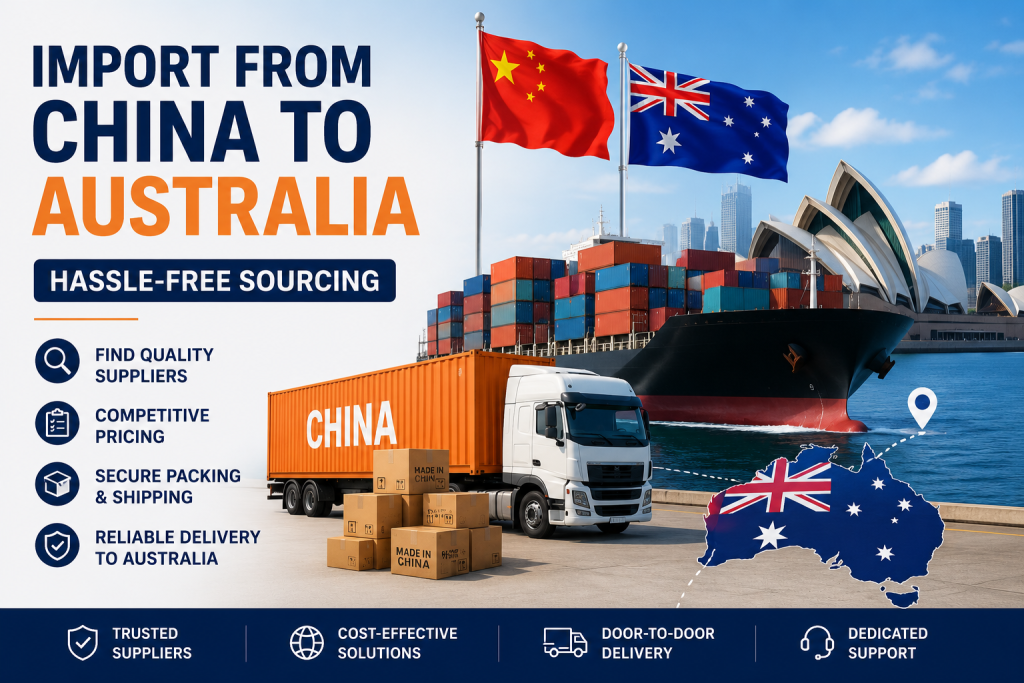
import from China to Australia Detail Guide
Why Import from China to Australia
Before we touch the how, let’s settle the why. Because the reasons Aussie businesses keep circling back to China are honestly hard to argue with.
Lower costs:
This is the headline act. China’s sheer manufacturing scale and cheaper production mean you can source goods for a sliver of what local suppliers ask. That gap lands straight in your pocket.
Massive product range:
Whatever you flog, China makes it. Electronics, homewares, clothing, tools, toys, packaging, the lot. The variety on offer makes the local scene look tiny by comparison.
Customization and private label:
Chinese factories are brilliant at building products to your exact spec, with your branding, your packaging, your little tweaks. Suddenly launching your own product line stops being a pipe dream.
Scalability:
Start tiny, then crank it up as you grow. Chinese suppliers happily handle a few hundred units or massive runs, stretching right alongside your business.
Competitive edge:
Cheaper inputs let you price keener, run bolder promos, or just bank fatter margins than rivals stuck paying local rates.
For Australian businesses getting serious about bulk product sourcing from China, the savings alone usually make the learning curve worth climbing.
What Can You Import?
Short answer? Pretty much anything. But it pays to know the lay of the land, especially the stuff that comes with strings attached.
Freely importable goods:
Most consumer products slot in here. Homewares, furniture, electronics accessories, clothing, toys, stationery, packaging, beauty tools, and a thousand others sail through with standard customs steps.
Regulated goods:
Some products demand extra permits, certs, or compliance checks. Think electrical goods (safety standards), kids’ products (safety rules), food and cosmetics (health regs), and anything wireless (ACMA compliance).
Restricted or prohibited goods:
A handful of items are locked down tight or banned outright. Certain chemicals, weapons, specific foods, protected wildlife products, knock-off goods. Always check before you source anything sitting in a grey zone.
The golden rule? Before you fall head over heels for a product, confirm it can legally land in Australia and what compliance it needs. According to the Australian Border Force, the importer carries the legal responsibility for making sure goods meet every Australian requirement, so this homework genuinely matters.
When you work with a China sourcing agent, checking product compliance for the Aussie market is baked into the service, sparing you nasty border surprises.
How to Find Reliable Suppliers
Here’s where most import dreams either soar or crash. A cracking supplier makes the whole thing glide. A dud turns the venture into a slow-motion disaster.
Where to look:
Online marketplaces like Alibaba, Made-in-China, and Global Sources are the usual launchpads. Trade shows like the Canton Fair are goldmines if you can get there. And sourcing agents hand you pre-vetted suppliers without the slog.
How to vet them:
Don’t swallow a glossy profile whole. Check business licenses, chase references, demand samples, and verify certifications. Hunt for suppliers who’ve actually exported to Australia before, since they’ll already get our market’s quirks.
Red flags to watch:
Prices that smell too good to be true. Dodging your sample requests. Pushy demands for the full payment upfront. Wishy-washy answers about certifications. Communication that suddenly goes ice cold.
Sample everything:
Never, ever fire off a bulk order without samples in hand first. A photo will happily lie to your face. A sample you can hold tells the real story about quality, materials, and whether the supplier actually delivers.
Build relationships:
The best suppliers turn into long-term partners. Treat them well, talk straight, and they’ll bump your orders up the queue, flag problems early, and sweeten your terms down the track.
This vetting stage is exactly where a sourcing partner earns their keep. For trickier or high-value sourcing, global sourcing expertise can be the line between a rock-solid supply chain and a pricey lesson.
Shipping from China to Australia
Once you’ve locked in a product and a supplier, you’ve got to physically haul the goods to Australia. Three main routes, each with its own give and take.
Sea freight:
The workhorse for most importers. Cheapest per unit, perfect for bulky or heavy loads. The catch? It crawls, usually 20 to 40 days depending on the ports. You can ship FCL (full container load) or LCL (less than container load) if you can’t fill a whole box.
Air freight:
Way faster, usually 3 to 10 days, but it’ll cost you noticeably more. Best for smaller, lighter, higher-value goods, or when you need stock yesterday. The per-kilo cost makes it a poor fit for bulky low-value gear.
Express courier:
Outfits like DHL, FedEx, and UPS run door-to-door in a few days. Brilliant for samples and small parcels, pricey for anything chunky. Often the comfiest option for first-timers, since couriers shoulder a lot of the customs hassle.
Choosing the right method:
It boils down to weight, value, urgency, and budget. A pallet of cheap homewares? Sea freight. A small batch of premium electronics needed fast? Air. A handful of samples? Courier. Plenty of businesses juggle all three depending on the order.
Whichever you go with, bake shipping into your total cost from day dot. A cheap product saddled with brutal freight can end up dearer than a pricier rival that ships lean.
Customs and Clearance
This is the bit that spooks people most, but it’s far tamer than it looks once you’ve got the basics down.
The clearance process:
When your goods touch down in Australia, they’ve got to clear customs before they’re released. That means declaring the goods, settling any duties and taxes, and ticking every regulatory box.
Using a customs broker:
For most importers, especially the fresh ones, a licensed customs broker is worth their weight in gold. They wrangle the declarations, classifications, and paperwork, making sure it’s all spot-on so your goods don’t get held up or slapped with penalties.
The $1,000 threshold:
Here’s a big one. Goods valued at AUD $1,000 or under generally clear with little fuss and no duty or GST at the border (though the rules here have tightened over the years). Above $1,000 and you’re into full import declarations, duties, and GST.
Quarantine and biosecurity:
Australia takes biosecurity dead seriously. Certain goods, especially anything touching wood, plants, food, or organic material, cop inspection from the Department of Agriculture. Dodgy packaging (think untreated timber) can trigger delays or fumigation bills.
Clearance timing:
With the right paperwork, clearance can be quick as a flash. With errors or missing docs, it can drag on while storage fees pile up. Which is precisely why nailing your documentation matters so much.
According to the Department of Agriculture, Fisheries and Forestry, biosecurity compliance is mandatory and not up for negotiation, so never wave this one off when importing.
Duties, Taxes and GST
Now the money question. What’ll you actually fork out on top of the product and shipping? Let’s pull it apart.
Customs duty:
Most goods imported into Australia attract a customs duty, often around 5%, though it swings by product type. Some goods come in duty-free, others carry heftier rates. The exact figure hinges on the product’s tariff classification.
Goods and Services Tax (GST):
GST of 10% lands on most imported goods. And here’s the kicker, GST is worked out on the value of the goods plus international freight, insurance, and any customs duty. So it’s 10% of the landed cost, not just the product price.
The China-Australia Free Trade Agreement (ChAFTA):
Now this is a genuine win. Under ChAFTA, loads of goods imported from China qualify for slashed or zero customs duty. To claim it, you’ll usually need a valid Certificate of Origin proving the goods were made in China. That can wipe out the entire duty bill, so it’s well worth chasing.
Other potential costs:
Customs brokerage fees, port handling, quarantine inspection charges, and local delivery all stack up. Fold these into your sums so your true landed cost holds no nasty surprises.
Calculating your landed cost:
Add the lot: product cost + shipping + insurance + customs duty + GST + brokerage + local delivery. That’s your real cost per unit. Always run these numbers before you commit, because a deal that dazzles on the product price can turn sour once everything’s tallied.
For accurate, current duty rates and ChAFTA eligibility, the Australian Taxation Office and a sharp customs broker are your best mates.
When you’re haggling with suppliers, weaving in these landed costs is the heart of smart supplier negotiation and cost optimization, since the cheapest product isn’t always cheapest once it actually lands in Australia.
Documents You Need
Paperwork can make or break a smooth import. Get these right and clearance is a breeze. Botch them and you’re staring down delays and fees.
Commercial invoice:
The core document, spelling out the goods, quantities, values, buyer, and seller. Customs leans on this to work out duties and GST, so accuracy is non-negotiable.
Packing list:
Itemizes exactly what’s in the shipment, with weights, dimensions, and how it’s packed. Helps customs and your broker double-check the consignment.
Bill of lading (sea) or air waybill (air):
The transport document and proof of shipment, issued by the carrier. It’s basically the title to your goods while they’re in transit.
Certificate of Origin:
Crucial for cashing in on ChAFTA perks. It proves the goods originated in China, unlocking reduced or zero duty. Make dead sure your supplier hands over a valid one.
Import declaration:
Lodged with customs (usually by your broker), declaring the goods and their value, which kicks off the duty and GST assessment.
Other certificates as needed:
Depending on the product, you might need compliance certificates, safety certs, fumigation certificates, or permits. Confirm what’s required before anything ships.
Keep these tidy and accurate and you’ve won half the battle. A reliable supplier and a good broker will help make sure nothing slips through the cracks.
Common Mistakes to Avoid
Plenty of importers learn these the hard way. Here’s how to skip the painful tuition fees.
Skipping samples:
Ordering bulk without sampling first is the classic faceplant. You might unbox products that look nothing like the listing. Always sample.
Ignoring the landed cost:
Getting dazzled by a low product price and clean forgetting shipping, duties, GST, and fees. The real cost is what counts, not the sticker.
Poor supplier vetting:
Trusting a supplier on blind faith, then bleeding money to scams, quality disasters, or ghost suppliers. Vet hard, every single time.
Neglecting compliance:
Importing goods that flunk Australian standards, then watching them get seized or finding you can’t legally sell them. Check compliance before you source.
Forgetting biosecurity:
Glossing over quarantine rules and copping inspection delays, fumigation bills, or bounced shipments. Mind the biosecurity.
No quality control:
Crossing your fingers the goods will be fine without ever checking. A pre-shipment inspection catches problems while you can still do something. This is exactly where independent quality control inspections earn their keep.
Cash-flow surprises:
Lowballing how long the whole process takes and tying your money up. Plan your timing and finances with both eyes open.
Sidestep these and you’re already streets ahead of most first-time importers.
The Step-by-Step Import Process
Let’s stitch it all into one clear roadmap you can actually follow.
Step 1: Research your product
Confirm there’s demand, check it can legally enter Australia, and get your head around any compliance hoops before going further.
Step 2: Find and vet suppliers
Round up candidates, check they’re legit, request samples, and confirm they can hit your quality and volume needs.
Step 3: Order and approve samples
Get samples in hand, put them through their paces, and confirm the quality stacks up before committing to bulk.
Step 4: Negotiate and place your order
Lock in price, terms, MOQ, payment terms, and timelines. Use a contract or clear purchase agreement to cover yourself.
Step 5: Arrange quality control
Book a pre-shipment inspection to verify the goods hit your standards before they leave China. Far cheaper than spotting problems after they land.
Step 6: Organize shipping
Pick your freight method, book the shipment, and pin down Incoterms (who’s on the hook for what and when) with your supplier.
Step 7: Handle customs and clearance
Team up with your customs broker to lodge declarations, pay duties and GST, claim your ChAFTA benefits, and clear biosecurity.
Step 8: Receive and inspect
Take delivery, check the goods against your order, and confirm everything turned up as promised.
Step 9: Sell and reorder
Get your products to market, and once they’re shifting, reorder through a supplier relationship that’s now smoother and more established.
Follow this run of steps and the whole thing stops being scary. Each step builds on the last, and the more you do it, the easier it gets.
Final Word on Importing from China to Australia
Importing from China to Australia isn’t some mysterious dark art locked away for big corporations. It’s a learnable process, and once the moving parts click into place, it turns into a genuine engine for building a profitable business.
The pattern’s obvious once you step back. The savings are real and serious. The product options are practically bottomless. And thanks to ChAFTA, the duty advantages make China an even sharper pick for Australian importers specifically. The catch is that winning hinges on doing the unglamorous bits properly: vetting suppliers, sampling products, checking compliance, nailing the paperwork, and working out your true landed cost.
Get those fundamentals locked and the rest just falls into line. Sea freight for bulk, air for the urgent runs, a good customs broker to grease the clearance, and a solid supplier relationship to build on. None of it is rocket science, but every piece of it counts.
Whether you’re shipping your first order or scaling an established operation, the principles never change. Do your homework, cover yourself at each step, and treat your suppliers like partners. Pull that off, and importing from China to Australia stops being a gamble and turns into a reliable, repeatable edge for your business.
The businesses that crush it at importing aren’t the lucky ones. They’re the ones who learned the process and worked it properly. And now you know the process too
Ready to import from China to Australia without the guesswork and headaches? Contact us to talk through your product and sourcing needs. Want expert help vetting suppliers, checking quality, and navigating shipping and customs? Book a consultation and we’ll help you build a smooth, reliable import process from China straight to your door in Australia.