
The 140th Canton Fair Phase 1 will take place from October 15 to 19, 2026, in Guangzhou, under the theme Advanced Manufacturing. Industrial automation and intelligent manufacturing are among the main product categories, alongside machinery, electronics, new energy, electrical products, hardware, and tools.
For buyers looking for industrial automation China Canton Fair suppliers, Phase 1 offers an opportunity to meet Chinese manufacturers, compare technologies, discuss customized solutions, and negotiate directly with suppliers.
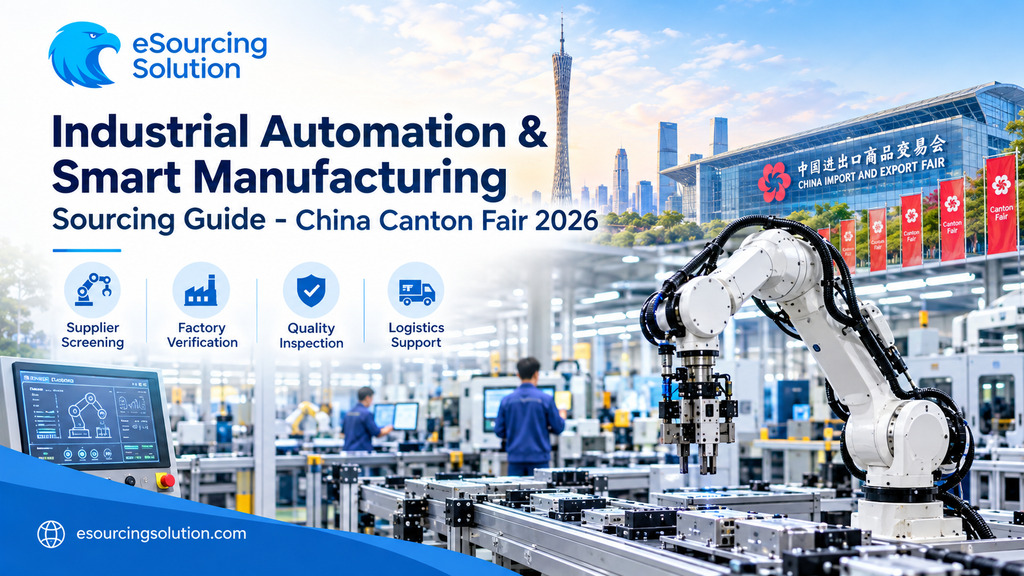
Table of Contents
Why Industrial Automation Is Transforming Manufacturing Globally
Manufacturers across different industries are investing in automation to improve production speed, consistency, quality, and efficiency. Robots, automated handling systems, machine vision, digital controls, and connected production equipment are being used for tasks that were previously handled manually.
China is one of the biggest markets for this technology. According to the International Federation of Robotics, 295,000 industrial robots were installed in China in 2024, representing 54% of global installations. China’s operational stock also exceeded 2 million industrial robots, the largest in the world. Chinese robot manufacturers held a 57% share of their domestic market in 2024.
This growth has created a broad supply base for overseas buyers. Instead of sourcing only complete robots, companies can source controls, motors, sensors, machine vision systems, conveyors, production equipment, and other components from China’s manufacturing ecosystem.
Large Chinese industrial equipment companies such as SANY and LiuGong also show how smart manufacturing and digital technologies are becoming part of China’s wider industrial sector. For overseas buyers, this development means there is an increasing range of suppliers to evaluate beyond traditional machinery manufacturers.
What’s on Display at Industrial Automation China Canton Fair Phase 1?
The official Canton Fair lists Industrial Automation and Intelligent Manufacturing as a Phase 1 exhibition section. Phase 1 also covers processing machinery, power and electrical equipment, general machinery, engineering machinery, agricultural machinery, new energy, vehicles, hardware, and tools.
Phase 1 is the most industrially focused part of the Canton Fair and highlights industrial automation, intelligent manufacturing, machinery, electronics, new energy, and other industrial technologies.
For automation buyers, some of the most relevant areas include:
Robotic Systems and Conveyor Automation
Buyers can look for robotic systems, automated handling equipment, palletizing systems, assembly solutions, conveyors, and other equipment designed to automate repetitive production tasks.
Do not compare robots only by price. Check payload, working range, cycle time, accuracy, programming, controller specifications, safety features, and whether the robot is suitable for your application.
Manufacturing Control Systems and IoT
Smart manufacturing depends heavily on control and communication systems. Depending on the supplier, buyers may find PLC-related equipment, industrial controls, monitoring systems, production data solutions, and industrial IoT technologies.
Ask suppliers how their systems communicate with existing factory equipment. Compatibility with your current PLC, MES, ERP, or other software can be just as important as the equipment itself.
Machine Vision and Quality Inspection
Machine vision systems can be used for product inspection, defect detection, measurement, sorting, identification, and quality monitoring.
A product demonstration at the fair can be useful, but ask suppliers to test your own product samples when possible. A system that works well in a general demonstration may not perform the same way on your actual product.
Material Handling and Logistics Automation
Material movement is another important area of factory automation.
Depending on your requirements, you may be interested in conveyors, robotic handling systems, automated transport equipment, warehouse automation, and other solutions that move products between workstations or storage areas.
Before buying, provide suppliers with product weight, dimensions, movement frequency, factory layout, and target production speed.
Assembly Line and Customized Automation Solutions
Some factories do not need a single automated machine. They need an entire production line.
In this case, look for manufacturers and system integrators that can combine robots, conveyors, sensors, controls, safety systems, and software into one working solution.
The wider machinery coverage of Canton Fair Phase 1 can be particularly useful for these projects because buyers can explore related production equipment during the same sourcing trip.
Read more about Canton Fair 2026 here.
Key Exhibitor and Manufacturer Categories
Automation sourcing involves more than finding a company that sells a machine. Understanding the different supplier categories can make your search easier.
- Industrial automation equipment manufacturers produce machinery and equipment used directly in manufacturing.
- System integrators combine different technologies into a complete production system. They may work with robots, conveyors, sensors, controls, software, and safety equipment.
- Component suppliers provide motors, sensors, drives, controllers, switches, actuators, and other parts used within automation systems.
- Software and control vendors focus on production monitoring, factory data, digital manufacturing, industrial IoT, and related systems.
- Service and integration partners can support installation, commissioning, training, maintenance, and technical troubleshooting.
That is important because the Canton Fair is extremely large. The 140th edition is expected to have more than 32,000 exhibiting companies and over 75,000 booths, making advance planning much more practical than simply walking through the halls without a shortlist.
How to Assess Automation Solutions at the Fair
A machine can look impressive at a trade show and still be the wrong choice for your production line.
Start by checking the technical specifications. Ask about:
- Production capacity and cycle time
- Accuracy and repeatability
- Equipment dimensions
- Power requirements
- Operating environment
- Maintenance needs
- Safety systems
- Expected service life
The next step is compatibility.
Tell the supplier what equipment and software you already have. Ask whether the new system can connect with your current PLC, MES, ERP, sensors, conveyors, or other equipment.
Also clarify who will be responsible for integration.
Before placing an order, ask:
- Which communication protocols are supported?
- What modifications are required?
- Will the supplier handle integration?
- What testing will be completed before shipment?
- Can the equipment be expanded later?
Scalability matters too. Your current requirement may be one automated line, but your factory may need additional production capacity later.
ROI Calculation: When Automation Pays for Itself
Automation should be evaluated as an investment rather than simply as an equipment purchase.
A basic payback calculation is:
Payback Period = Total Automation Investment ÷ Annual Net Savings
For example, if an automation project costs $150,000 and generates approximately $60,000 in annual net savings, the simple payback period would be:
$150,000 ÷ $60,000 = 2.5 years
However, buyers should calculate more than labor savings.
Consider:
- Labor savings: How many actual work hours can be reduced or reassigned?
- Production increase: Will automation allow the factory to produce more units per shift?
- Quality improvement: Can it reduce defects, rework, and material waste?
- Downtime: Will the system reduce production stoppages?
- Maintenance: What will spare parts, servicing, and software support cost?
- Energy: Will the automated system consume more or less energy than the current process?
Use your actual production figures when calculating ROI instead of relying only on figures provided by a supplier.
Negotiating Automation Contracts at the Fair
A low equipment price does not necessarily mean a low total project cost.
- Ask for an itemized quotation showing the cost of equipment, customization, software, integration, installation, commissioning, testing, training, and spare parts.
- For larger projects, negotiate volume discounts based on the total number of machines or production lines you expect to purchase.
- Payment terms should also be discussed carefully. For expensive automation projects, buyers may negotiate payments around manufacturing milestones, factory acceptance testing, shipment, installation, and final acceptance.
- Training should be clearly included in the quotation or contract. Specify whether the supplier will train operators, maintenance staff, or both.
- Documentation is another important point. Request operating manuals, electrical diagrams, software information, spare-parts lists, maintenance instructions, and troubleshooting documents.
- Finally, discuss after-sales service before signing.
- Ask about warranty coverage, remote technical support, spare-parts availability, response times, and responsibility for resolving integration problems.
Common Pitfalls When Sourcing Automation From China
One of the most common mistakes is assuming new equipment will automatically work with existing machinery.
- Compatibility must be checked before the purchase order is signed. Technical specifications, communication protocols, software requirements, electrical details, and integration responsibilities should be documented.
- Hidden costs are another concern. A factory price may not include installation, engineering, software configuration, commissioning, training, or factory modifications.
- Lead time also needs to be viewed as a complete project timeline.
- Ask the supplier to separate the time needed for engineering, production, testing, shipping, installation, and commissioning.
- Technical support should also be assessed carefully. A supplier may manufacture good equipment but have limited experience supporting customers in your country.
- Ask whether remote support is available, where spare parts are stocked, and how quickly replacement components can be supplied.
- Poor training and documentation can create problems after installation as well. Your operators and maintenance team should know how to use, troubleshoot, and maintain the system before it goes into full production.
Building Long-Term Relationships With Automation Suppliers
Automation is usually a long-term investment, so your relationship with the supplier should not end when the machine is shipped.
A pilot project can be a useful first step. Rather than automating an entire factory immediately, buyers can test one process or production line and measure actual performance.
Look at cycle time, quality, downtime, maintenance requirements, operator feedback, and supplier response time.
You should also ask about the supplier’s future upgrade path.
Can additional robots be added later? Can the software support more production lines? Can new machines connect to the same monitoring system?
For larger automation projects, ongoing maintenance or technical support agreements may also be worthwhile.
Certifications are another area to verify. Ask suppliers for copies of the relevant certificates, test reports, and technical documents for your destination market.
The cheapest supplier is not always the best supplier. Reliability, integration experience, technical support, documentation, and future scalability can have a much greater effect on the total cost of ownership.
How to Prepare for Canton Fair Phase 1
A successful Canton Fair sourcing trip starts before you arrive in Guangzhou.
Prepare a basic automation requirement sheet containing:
- Current production process
- Product dimensions and materials
- Current production volume
- Target production volume
- Current cycle time
- Required automation level
- Factory layout
- Existing machinery
- PLC, MES, or ERP information
- Electrical requirements
- Required certifications
- Target budget
- Desired installation date
Bring product samples, technical drawings, factory layout information, production videos, and equipment specifications where possible.
This gives suppliers enough information to provide more relevant solutions and quotations.
It is also worth arranging supplier meetings in advance. The official Canton Fair platform provides overseas buyer pre-registration, invitation services, buyer badge information, and exhibitor and product search tools.
With such a large exhibition, a planned schedule will help you spend more time with relevant suppliers instead of trying to cover every booth.
Final Thoughts
The 140th Canton Fair Phase 1 is a strong opportunity for manufacturers looking to explore China’s industrial automation and smart manufacturing supply base. Running from October 15 to 19, 2026, Phase 1 brings together industrial automation, intelligent manufacturing, machinery, electronics, electrical products, new energy, hardware, and other advanced manufacturing categories.
For serious buyers, the goal should not simply be to find the cheapest automation equipment. The right supplier needs to meet your technical requirements, integrate with existing systems, provide reliable support, and offer a solution that makes financial sense over the long term.
Our eSourcingSolution team will be present throughout Phase 1 of Canton Fair 140 to help you evaluate industrial automation solutions, connect with manufacturers, and negotiate integration contracts. Schedule your free automation sourcing consultation.
Frequently Asked Questions
How long does automation implementation take?
It depends on the project. Standard equipment may require a shorter installation period, while customized production lines involving robotics, software, and integration can take several months.
What support do automation suppliers provide after installation?
It varies by supplier. Support may include warranty service, remote troubleshooting, spare parts, maintenance, software support, and operator training. Always confirm the details in the contract.
Can industrial automation systems be customized?
Yes. Suppliers can often customize systems based on production volume, product specifications, factory layout, cycle time, and existing machinery.
What is the typical ROI timeline for factory automation?
There is no fixed timeline. Payback depends on equipment cost, labor savings, production increases, quality improvements, maintenance, energy use, and equipment utilization.
How do I verify system compatibility?
Give the supplier your existing machinery specifications, PLC and communication details, electrical requirements, software environment, and factory layout. Ask for compatibility confirmation in writing before placing the order.