
Mexico is an export-oriented market, with exports estimated at $27 billion per month, accounting for around 14% of its GDP.
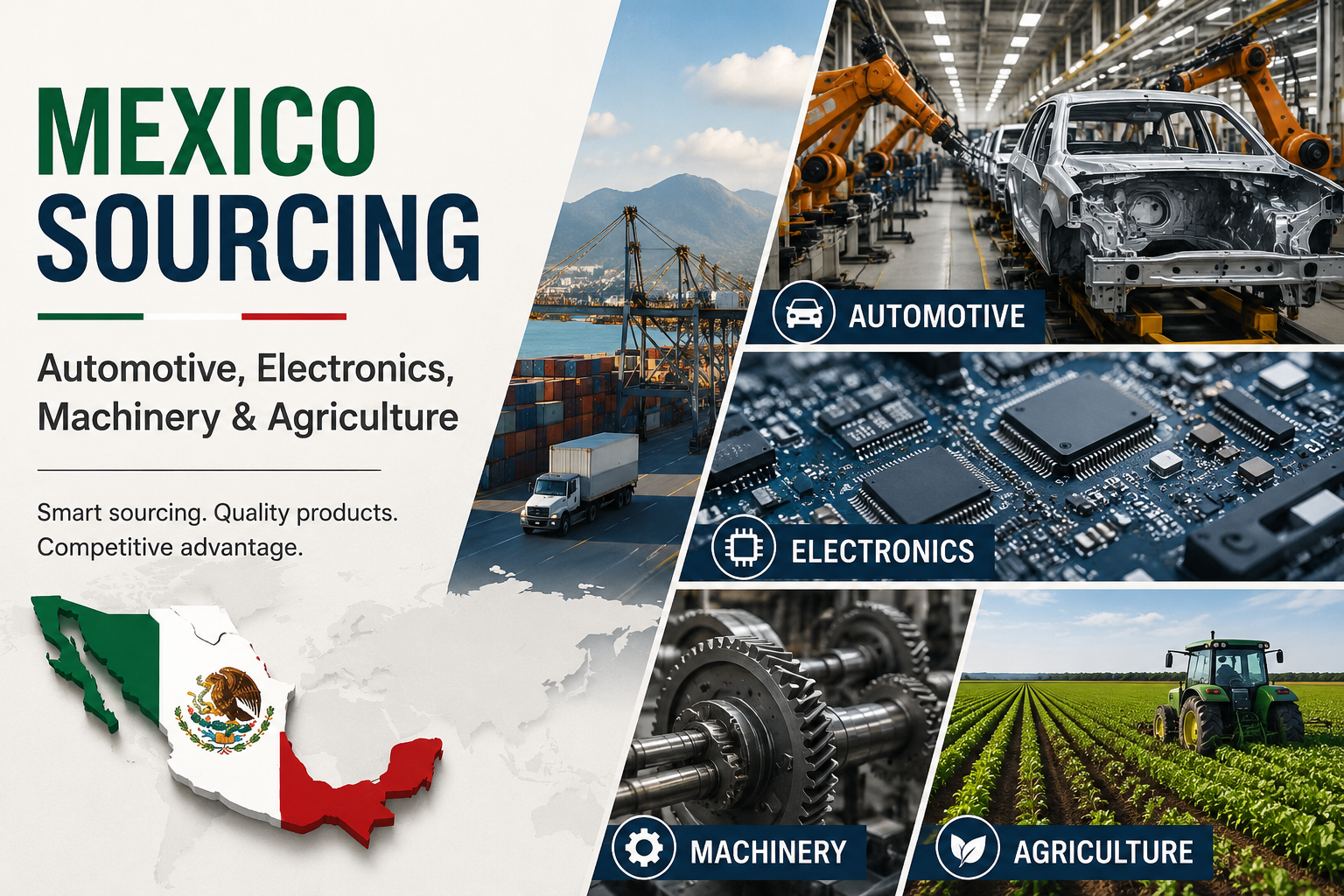
Mexico has become the word on every supply chain executive’s lips since 2020. Nearshoring. Friend-shoring. China-plus-one. Whatever the buzzword, the destination is the same: Mexico. Monthly exports of USD 27 billion make it the world’s 12th-largest exporter. But here is what matters more than the headline number: 80% of those exports cross one border. The US border. Mexico is not just a manufacturing country. It is an extension of the American industrial economy, connected by rail lines, highways, shared supply chains, and a trade agreement (USMCA) that makes cross-border commerce nearly frictionless. For any company selling into the United States, Mexico sourcing is not an exotic alternative. It is the obvious move that competitors have already made.
Mexico Sourcing: Market Overview & Nearshoring Advantage
Mexico sourcing exploded after COVID exposed the fragility of trans-Pacific supply chains. When containers from Shanghai cost USD 20,000 and took 60 days to arrive, factories in Monterrey kept shipping by truck to Texas in 48 hours. That lesson stuck. Foreign direct investment into Mexican manufacturing hit record levels in 2022 and 2023. Tesla, BMW, and dozens of Chinese companies announced new plants. The nearshoring wave is not speculation. It is visible in construction cranes across northern Mexico right now.
USMCA (the trade agreement replacing NAFTA in 2020) provides duty-free access to the United States and Canada for qualifying goods. Rules of origin requirements mean products must contain sufficient North American content, which drives component manufacturing into Mexico rather than simply assembling Chinese parts for re-export. This is genuine manufacturing relocation, not tariff arbitrage.
Mexico also maintains free trade agreements with 50 countries, including the EU, Japan, Israel, and most of Latin America. A factory in Mexico can export duty-free to more markets than almost any other manufacturing location on earth. That network of agreements is why BMW builds 3 Series sedans in San Luis Potosi for global export, not just for North America.
Labour costs run 30-40% below the United States but have risen significantly in recent years. Mexico is not the cheapest option globally. Vietnam and India undercut Mexican wages. But when you add shipping costs, transit time, inventory carrying costs, tariff exposure, and supply chain risk to the calculation, Mexico’s total landed cost to the US market beats Asia for most manufactured goods. That math is why the factories keep coming.
Products to Source from Mexico
Automobiles and Auto Parts. Mexico is the world’s seventh-largest vehicle producer. BMW, Audi, Mercedes-Benz, Toyota, Nissan, GM, Ford, Stellantis, and Kia all operate assembly plants. The auto parts supply chain employs over 900,000 workers producing engines, transmissions, wiring harnesses, seating, braking systems, and electronics. Nuevo Leon, Coahuila, Guanajuato, Puebla, and San Luis Potosi are primary automotive states.
Electronics. Television assembly (Mexico produces more flat-screen TVs than any country except China), computers, smartphones, medical devices, and electronic components. Baja California (Tijuana, Mexicali) and Jalisco (Guadalajara, known as Mexico’s Silicon Valley) host major electronics clusters. Samsung, LG, Foxconn, and Jabil all manufacture here.
Machinery and Industrial Equipment. CNC machines, injection moulding equipment, packaging machinery, and agricultural equipment. Mexico’s machinery sector serves both domestic industry and US manufacturers seeking lower-cost capital equipment.
Aerospace. Bombardier, Safran, GE Aviation, and Honeywell operate in Queretaro, Mexico’s aerospace capital. The sector has grown from nearly zero to over 400 companies in two decades, producing turbine blades, landing gear components, wiring harnesses, and fuselage sections.
Medical Devices. Baja California hosts one of the world’s largest medical device manufacturing clusters. Becton Dickinson, Medtronic, Cardinal Health, and dozens of contract manufacturers produce catheters, surgical instruments, diagnostic equipment, and disposables. Over USD 15 billion in annual medical device exports.
Agricultural Products. Avocados (Mexico supplies 80% of US consumption), tomatoes, berries, peppers, tequila, beer, and tropical fruits. Jalisco, Michoacan, Sinaloa, and Sonora are primary agricultural export states.
Oil and Petroleum Products. Crude oil, refined fuels, and petrochemical derivatives. Pemex remains the national oil company, though recent reforms opened the sector to private investment.
Furniture. Office furniture, residential furniture, and hospitality fit-outs. Primarily serving the US market from factories in northern Mexico with same-week delivery capability.
Challenges in Mexico Sourcing and Our Approach
Mexico sourcing is not without serious concerns. Security remains the elephant in the room. Cartel activity affects certain regions, and logistics routes require security planning that buyers from safer markets find uncomfortable. Labour availability is tightening as nearshoring demand outpaces workforce growth, particularly for engineers and skilled technicians. The USMCA rules of origin are complex, and non-compliance can trigger tariff exposure that eliminates the cost advantage entirely. Water scarcity in northern industrial states (Nuevo Leon experienced severe drought in 2022) threatens manufacturing continuity. And while infrastructure in the north is strong, southern Mexico lacks the industrial ecosystem that makes nearshoring work.
Our team addresses these realities directly. We recommend suppliers in established industrial corridors with proven security track records. We verify USMCA compliance documentation to protect your duty-free status. We assess workforce stability and turnover rates during factory audits. We focus recommendations on states with reliable infrastructure: Nuevo Leon, Coahuila, Queretaro, Guanajuato, Jalisco, and Baja California. And we build contingency into logistics planning for the occasional disruption that Mexican supply chains experience.
How We Support Your Mexico Sourcing
eSourcingSolution provides comprehensive Mexico sourcing services for businesses building North American supply chains or diversifying away from Asian manufacturing dependency. Our procurement intelligence delivers factory-level cost analysis benchmarked against US domestic production, Chinese imports, and other nearshore alternatives. Quality control inspections verify automotive-grade and medical-device-grade standards throughout production.
The Mexican Ministry of Economy promotes foreign investment and provides sector-specific incentive data for manufacturing operations. The Mexican Business Council for Foreign Trade (COMCE) facilitates international trade connections and publishes market intelligence across industrial sectors.
We handle supplier identification, factory audits, USMCA compliance verification, sample development, production monitoring, and cross-border logistics coordination. Whether you need automotive parts from Monterrey, electronics from Guadalajara, aerospace components from Queretaro, or medical devices from Tijuana, our network covers Mexico’s industrial geography.
Ready to explore Mexico sourcing for your North American supply chain? Contact us for a free supplier assessment and landed-cost comparison against your current Asian or domestic sources.
Mexico has built an extensive network of free trade agreements with over 40 countries, including the United States, Canada, the European Union, Japan, Israel, and numerous nations across South and Central America. These trade agreements make Mexico one of the most open economies for international trade.
Over 80% of Mexico’s exports go to the United States, followed by Canada, Germany, and other key partners in Europe and Latin America.

Below are answers to common questions about eSourcingSolution, our services, and how we work. If you need more details, feel free to reach out — our team is ready to help!
We can source a wide range of goods and services — from raw materials and commodities to custom-engineered products and specialized services. Visit our Category Expertise page to explore what we cover.
We work with startups, SMEs, and global enterprises that want to source more competitively from emerging and developed markets, strengthen supply chains, and access reliable procurement support.
Yes. We maintain strong partnerships with a global network of vetted, reliable suppliers across multiple industries, ensuring quality, compliance, and long-term value.
Our proven qualification process, supported by local teams and digital audits, can fully onboard a new supplier in as little as 4–8 weeks, depending on category and compliance needs.
Using real-time market data, cost analysis, and sourcing intelligence, we can quickly evaluate potential savings, benchmark costs, and highlight key opportunities — typically within a few weeks.
It’s easy to begin — just reach out through our Contact page. We’ll arrange a quick discovery call, understand your goals, and design a customized sourcing plan to help you unlock better value.