
Finding products to source from Shenzhen sounds like a great opportunity for your business. And it really is. But here’s the thing: picking the wrong sourcing agent can cost you far more than you’d expect. We’re talking about delayed shipments, quality problems, and suppliers who suddenly stop responding to your messages.
Shenzhen is packed with factories and manufacturers. It’s one of the best places in the world to source products. But if you don’t have someone local who knows the area, it’s really hard to navigate everything. That’s exactly why businesses hire a Shenzhen sourcing agent. The problem is, not all agents are created equal.
When you work with the right sourcing agent in Shenzhen, everything becomes easier. You get better prices, consistent quality, and someone who can actually visit factories and check your products in person. But hire the wrong person? You’re looking at products that don’t match what you ordered, surprise costs that eat into your profit, and months of back-and-forth that lead nowhere.
Let us walk you through each of these mistakes so you can avoid them and find a Shenzhen sourcing agent who actually helps your business grow instead of creating more obstacles.
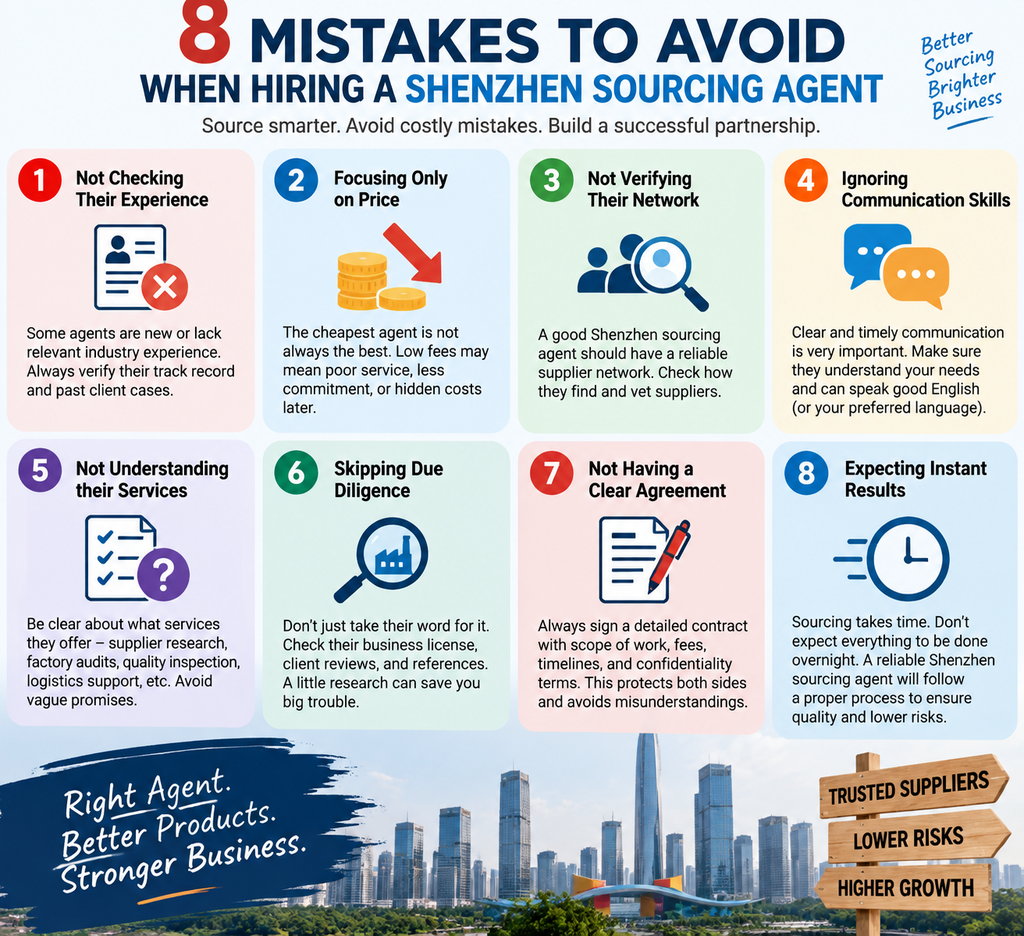
1. Not Verifying Their Physical Presence in Shenzhen
This is probably the mistake most businesses make. A lot of agents say they’re “based in Shenzhen” on their website. But when you dig deeper, you find out they’re actually working from another city, another country, or just from their laptop at home.
Why does this matter so much? Because a real Shenzhen-based sourcing agent can actually go to the factories. They can show up unannounced to check quality. They can meet with factory owners face to face and build real relationships.
Remote agents can’t do any of this. They rely on photos, video calls, and promises from suppliers. Sometimes they hire third-party inspection companies, which adds more cost and less accountability. You’re basically paying someone to do what you could do yourself from your office.
Before you sign anything, ask for their office address. Check it on Google Maps. If they hesitate or give vague answers, that’s a big red flag right there.
2. Skipping Reference Checks and Case Studies
Too many businesses make hiring decisions based on a nice-looking website and some testimonials. But here’s what you should do instead: ask for real references from actual clients. A professional Shenzhen sourcing agent should have no problem connecting you with businesses they’ve worked with before.
Ask for at least three references from companies that are similar to yours in size and product type.
- When you contact these references, ask specific questions.
- How did the agent handle problems when quality wasn’t right?
- Did shipments arrive on time consistently?
- Were there surprise costs that weren’t mentioned upfront?
- Would they hire this agent again for their next order?
A good Shenzhen sourcing agent will happily introduce you to satisfied clients.
3. Ignoring Their Supplier Network and Factory Relationships
Not all Shenzhen sourcing agents have the same connections with factories. Some agents have spent years building relationships with specific manufacturers. Other agents? They just search on Alibaba and send you factory contacts. You could do that yourself for free. You’re not getting any real value from them.
When a sourcing agent in Shenzhen has strong factory relationships, they can negotiate much better prices because factories know they’ll bring regular business. They can get lower minimum order quantities.
Request a list of factory categories they specialize in. Ask to see recent photos or reports from factory visits. Established agents will have tons of documentation – factory certifications, audit reports, production capacity information, and ongoing communication records with factory managers.
4. Failing to Clarify the Full Fee Structure Upfront
Money conversations can feel awkward, but you absolutely need to have them before hiring any agent. Sourcing agents charge in different ways, and if you don’t clarify everything upfront, you’ll get surprised by costs you didn’t expect. Those surprise costs can completely destroy your profit margins.
Some Shenzhen sourcing agents charge a percentage of your order value, usually between 5% and 10%. Others charge flat fees per project. And some earn commissions directly from factories – which creates a big problem because they might recommend more expensive factories just to earn higher commissions.
Before you hire anyone, get everything in writing. You need a breakdown of all fees, including sourcing fees, inspection costs, logistics coordination, payment processing charges, and any markups they add to the product price. Ask them directly if they receive any commissions or rebates from suppliers.
5. Not Defining Quality Standards and Inspection Protocols
This is where a lot of quality disasters happen. If you hire a Shenzhen sourcing agent without writing down exactly what quality means for your product, you’ll receive items that meet the factory’s standards, not yours.
Create a detailed product specification document. Include everything: materials, exact dimensions, finishes, packaging requirements, labeling details, and any certifications you need, like CE marking for European markets or FDA compliance for the United States. Give this document to your agent and make sure they confirm in writing that the factory can meet every single requirement.
6. Overlooking Communication Skills and Responsiveness
A Shenzhen sourcing agent connects you to Chinese manufacturers. If communication is poor, your entire project suffers. Bad communication leads to misunderstood product specs, missed deadlines, unsolved quality problems, and constant frustration. Yet so many buyers don’t test communication properly before hiring.
Time zones are already challenging. Shenzhen is 12 to 16 hours ahead of North America and 7 to 8 hours ahead of Europe. If your agent is also slow to respond or doesn’t communicate clearly, these challenges become major obstacles.
Test their communication by asking some technical questions about your product category. Can they explain manufacturing processes, material options, and quality standards in terms you understand? Do they ask clarifying questions when something’s unclear, or do they just make assumptions?
7. Signing Contracts Without Legal Protection
A lot of B2B buyers work with China sourcing agents using just informal agreements or brief email confirmations. This leaves you legally exposed when problems happen. The cultural and legal differences between Western business and Chinese business make proper contracts even more important.
If you’re working with proprietary designs or branding, include a strong non-disclosure agreement. Product copying is a real risk in China, and an NDA backed by legal consequences is your first defense. Some buyers also register their trademarks and patents in China through the China National Intellectual Property Administration.
Consider having a lawyer who knows international trade and Chinese business law review your contract, especially if your orders are large or involve significant intellectual property. Some Shenzhen sourcing companies operate through Hong Kong or other jurisdictions, which affects which laws apply and where you’d resolve disputes.
8. Not Testing with a Small Trial Order First
Don’t jump into a huge production run with an untested Shenzhen sourcing agent. Even if they have great references and seem perfect, you won’t really know how well you work together until you’ve completed an actual project with real stakes involved.
Start with a smaller trial order. This trial lets you evaluate their supplier selection and factory vetting, quality control procedures, and how thorough inspections really are, communication during production when issues come up, problem-solving when unexpected challenges happen, and logistics coordination from factory to your door.
The trial also tests whether they meet deadlines, stay within budget, and deliver products matching your specifications. You’ll learn if their quality control actually catches defects or just approves everything.
Conclusion
Hiring the right Shenzhen sourcing agent can transform your business, while choosing the wrong one can cost you thousands in delays, quality issues, and wasted time. The eight mistakes we’ve covered are all completely avoidable with proper due diligence, clear communication, and starting with a trial order.
Searching for reliable China sourcing agents? Contact eSourcing Solution today to find trusted suppliers, reduce sourcing risks, and improve product quality. Book your free consultation now!
FAQS
How much should I expect to pay a Shenzhen sourcing agent?
Most agents charge between 5% and 10% of your total order value. Some use flat project fees instead, especially for smaller orders. Always clarify whether their fee includes factory visits, quality inspections, and logistics support, or if those cost extra.
What’s the difference between a sourcing agent and a trading company?
A sourcing agent works for you to find and manage suppliers. They usually charge a service fee and show you the actual factory pricing. A trading company buys from factories and resells to you at a markup, often without telling you which factory made the products or what they originally cost.
Can a sourcing agent help with product development and customization?
Many experienced sourcing agents offer product development support like finding factories for prototyping, coordinating with engineers, sourcing materials, and managing sample iterations. But this is a specialized service that not all agents provide. Make sure to ask about their capabilities upfront if you need design or customization help beyond just finding standard products.
What red flags should make me walk away from a sourcing agent?
Major warning signs include unwillingness to provide client references, vague or changing fee structures, no physical office in China, pressure to commit to large orders immediately without a trial, poor English communication skills, and getting defensive when you ask questions about their process.