
Ever wonder where your stuff actually comes from?
Check the labels on your phone, clothes, kitchen gadgets, basically anything. Bet a lot say “Made in China.” Dig a little deeper and you’ll find most come from one specific spot: the Pearl River Delta.
This chunk of southern China cranks out more products than entire countries do. It’s where raw materials become finished goods that end up on store shelves worldwide. If you’re buying anything from China, knowing about the Pearl River Delta isn’t optional. It’s mandatory.
Here’s the full story on this manufacturing beast.
Table of Contents
| # | Topic | What You’ll Learn |
| 1 | What is the Pearl River Delta? | Definition and overview |
| 2 | Geographic Location | Where it is and what it includes |
| 3 | Major Cities in the PRD | Key urban centers and their roles |
| 4 | The PRD Megacity Concept | Greater Bay Area integration |
| 5 | Manufacturing Industries | What’s produced here |
| 6 | Major Ports and Logistics | Shipping infrastructure |
| 7 | Economic Significance | Why it matters globally |
| 8 | Infrastructure and Transportation | How everything connects |
| 9 | Evolution and History | How it became what it is |
| 10 | Advantages for Manufacturing | Why companies choose PRD |
| 11 | Challenges and Changes | Current issues and trends |
| 12 | Future Outlook | Where it’s heading |
| 13 | Sourcing from the PRD | Practical tips for buyers |
What is the Pearl River Delta?
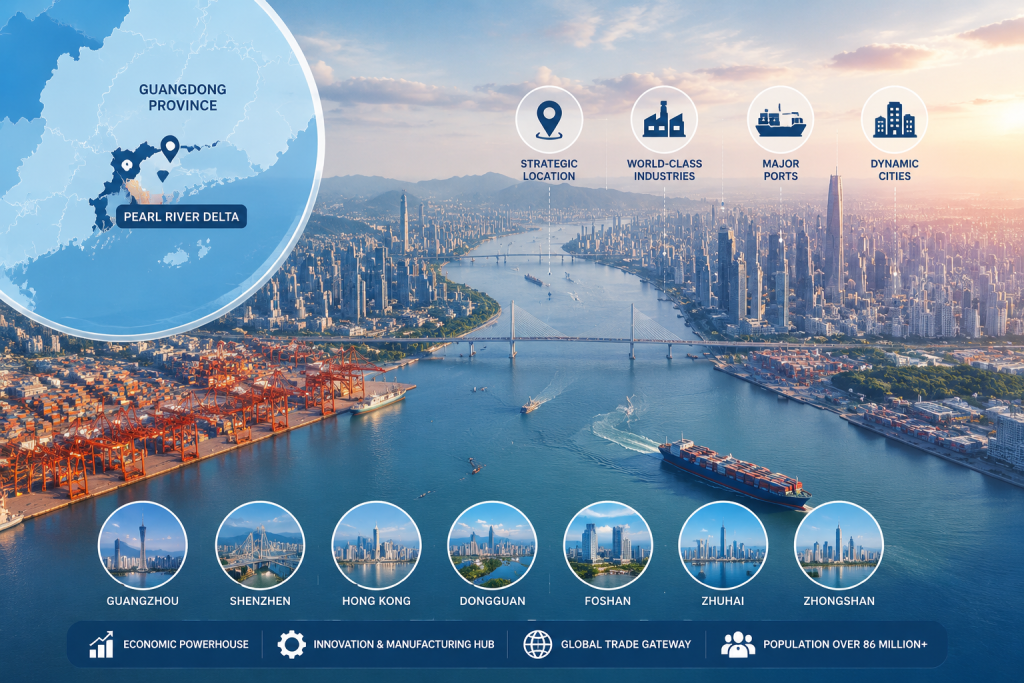
The Pearl River Delta (PRD), or Zhujiang Delta if you want the Chinese name, is this massive urban sprawl in southern China’s Guangdong Province.
What it actually is:
Basically where the Pearl River dumps into the South China Sea. But when business folks talk about “the Pearl River Delta,” they mean way more than just geography. They’re talking about the entire economic zone that’s grown around it.
How big we talking:
About 56,000 square kilometers. Sounds huge until you realize over 65 million people are crammed in there. That’s more people than the entire UK, packed into an area smaller than West Virginia.
Why everyone cares:
Densest concentration of factories on the planet. Cities everywhere. World-class shipping ports. Complete supply chains for basically anything you can think of. Everything you need to manufacture almost any product, all within a couple hours’ drive.
The World Bank says the Pearl River Delta pulls in roughly 9% of China’s entire GDP despite only having about 5% of the population. That’s some serious economic firepower concentrated in one spot.
Doing bulk product sourcing from China? You’re dealing with the PRD whether you know it or not.
Geographic Location
Where you’ll find it:
Southern China, Guangdong Province. South China Sea sits to the south. Hong Kong and Macau (those Special Administrative Regions with their own rules) are right at the delta’s mouth.
The river situation:
Pearl River isn’t just one river. It’s a whole network. Three main rivers feed it: Xi River (West), Bei River (North), Dong River (East). They all converge, flow through the delta, and empty into the South China Sea through eight different outlets.
Exact coordinates:
Roughly sits between 22°N to 24°N latitude and 112°E to 114°E longitude.
Weather:
Subtropical climate. Summers are brutal—hot and humid, hitting 35°C (95°F) with moisture that makes you feel like you’re swimming through air. Winters are mild, rarely dropping below 10°C (50°F). Typhoon season runs June to October. Rain comes heavy, especially May through September.
Land itself:
Flat delta plains. Low elevation everywhere. Tons of waterways and canals crisscrossing. Land is still being created through reclamation projects, literally building new ground.
Why the location matters:
Close to Southeast Asia. Easy access to major shipping lanes. Hong Kong and Macau provide connections to global money markets and different legal systems. Acts as a gateway between mainland China and everywhere else.
What’s included:
Core PRD covers nine cities: Guangzhou, Shenzhen, Dongguan, Foshan, Zhongshan, Zhuhai, Huizhou, Jiangmen, Zhaoqing. Expanded Greater Bay Area throws in Hong Kong and Macau too.
Major Cities in the PRD
Each city’s got its own vibe and specialty:
Guangzhou (Canton):
Provincial capital. Around 15 million people. Historic trading port that’s been doing international business for centuries. Hosts the Canton Fair twice a year—that’s China’s biggest trade show. Mix of old-school commerce and modern manufacturing. Strong in electronics, cars, petrochemicals.
Shenzhen:
The miracle city. Went from fishing village to megacity in 40 years flat. Around 13 million people now. Right next door to Hong Kong. China’s tech capital. Home base for Huawei, Tencent, DJI, BYD. Electronics manufacturing everywhere. Massive ports.
Dongguan:
Factory central. Around 8 million people. Sits right between Guangzhou and Shenzhen. Known as “world’s factory floor,” and it’s not an exaggeration. Electronics, textiles, furniture, toys—you name it. Contract manufacturers everywhere. Need something made in China? Dongguan probably has a factory that does it.
Foshan:
Around 8 million people. Traditional manufacturing hub. Ceramics, home appliances, furniture, textiles. Known for craftsmanship and quality. Less flashy than Shenzhen but serious production muscle.
Zhuhai:
Around 2 million people. Borders Macau. Special Economic Zone status. Growing focus on high-tech and clean energy. More laid-back than other PRD cities.
Zhongshan:
Around 3 million people. Between Guangzhou and Zhuhai. Lighting products, hardware, home appliances. Named after Sun Yat-sen (Zhongshan was his courtesy name).
Huizhou:
Around 5 million people. East of Shenzhen. Electronics and petrochemicals. Growing fast, absorbing overflow from Shenzhen’s expansion.
Jiangmen:
Around 4 million people. Western PRD. Motorcycles, textiles, food processing. Large overseas Chinese community with connections abroad.
Zhaoqing:
Around 4 million people. Northern PRD. Automotive parts, electronics, building materials. Less developed than core cities but catching up.
Hong Kong:
Special Administrative Region. Population 7.5 million. International financial center. Major port. Different legal system from mainland. Gateway for international business moving into China.
Macau:
Special Administrative Region. Population 700,000. Gaming and casino capital of Asia. Portuguese colonial influence still visible. Another gateway with its own legal framework.
Each city has industrial clusters and specializations. Knowing which city makes what saves you tons of time when sourcing. A China sourcing agent who actually knows these differences is worth their weight.
The PRD Megacity Concept
China’s pushing hard to integrate the PRD into one gigantic megalopolis called the Guangdong-Hong Kong-Macau Greater Bay Area (GBA).
The big plan:
Connect all these cities into one functional economic zone. Make it better than Tokyo, New York, or San Francisco Bay Area. Turn it into a world-class innovation hub. Make goods, people, money, and information move seamlessly everywhere.
How they’re connecting it:
High-speed rail linking major cities (30 minutes from Guangzhou to Shenzhen). Hong Kong-Zhuhai-Macau Bridge—longest sea crossing bridge in the world at 55km. Express highways everywhere you look. Metro systems expanding like crazy. Airports coordinating schedules.
Making it work economically:
Harmonizing regulations where they can. Making it easier for companies to operate across the whole region. Encouraging each city to specialize in what it does best. Creating one unified talent market.
Why this matters:
Creates one massive market of 86 million people. Combined GDP over $1.6 trillion, bigger than most countries. Concentrates innovation, manufacturing, and logistics in one connected system.
The problems:
Different legal systems (mainland vs Hong Kong/Macau creates headaches). Political considerations nobody talks about publicly. Coordinating so many local governments with their own agendas. Environmental concerns when you pack this many people and factories together.
McKinsey thinks the GBA could become the world’s largest urban economy by 2030. That’s the goal anyway.
For businesses, this megacity concept means even tighter supply chain integration. Factory in Dongguan, port in Shenzhen, financial services in Hong Kong, design team in Guangzhou—all within an hour of each other.
Manufacturing Industries
The PRD makes basically everything. Here’s what it’s famous for:
Electronics and Tech:
The big kahuna. Smartphones, computers, components, consumer electronics. Shenzhen alone produces a ridiculous percentage of the world’s electronics. Complete supply chains from tiny components to final assembly.
Textiles and Clothing:
Clothing, fabric, accessories. A lot has moved to cheaper regions now, but high-end and technical textiles still happen here.
Toys:
Huge chunk of the world’s toys get made here. Dongguan especially. Plastic toys, stuffed animals, games, you name it.
Furniture:
Home and office furniture. Shunde district in Foshan is furniture central. Everything from budget to high-end.
Home Appliances:
Midea, Galanz, other major appliance brands are based here. Small appliances especially strong.
Automotive and Parts:
Complete vehicles and components. Electric vehicle production growing fast. BYD in Shenzhen is a major EV player globally.
Lighting Products:
Zhongshan cranks out massive amounts of lighting. LEDs, fixtures, components, all of it.
Jewelry and Watches:
Shenzhen has a huge jewelry industry. Watch components and assembly too.
Packaging:
All kinds of packaging materials and printing. Supports all the other manufacturing.
Hardware and Tools:
Hand tools, power tools, hardware products of every type.
Medical Devices:
Growing sector. Everything from simple items to complex equipment.
Basically anything:
Seriously, think of a product category. There’s probably a cluster of factories in the PRD making exactly that. The supply chain depth is insane. Need a specific screw type? There’s a factory making only that screw. Need it in a different finish? Another factory specializes in that exact finish.
That’s the PRD’s superpower. Complete ecosystems for manufacturing. When working on product idea development, the PRD has prototyping services, mold makers, material suppliers, assembly facilities—all nearby.
Major Ports and Logistics
The PRD moves goods worldwide through some seriously impressive ports:
Port of Shenzhen:
One of the world’s busiest container ports. Actually multiple port areas: Yantian, Shekou, Chiwan, Mawan. Combined capacity over 28 million TEUs (those twenty-foot equivalent container units). Yantian handles most international containers.
Port of Guangzhou:
China’s fifth-busiest port. Handles containers, bulk cargo, cars. Over 24 million TEUs capacity. Multiple terminals scattered along the river.
Port of Hong Kong:
Used to be THE port. Still major but declining slightly as Shenzhen grows. Around 18 million TEUs. Still important for international connections and finance.
Zhuhai Port:
Smaller player but growing. Good access to western PRD areas.
What these ports have:
Modern container terminals with the latest tech. Automated systems handling cargo. Excellent customs clearance that actually works. Warehousing facilities everywhere. Bonded zones for trade. Everything you need for international shipping.
Logistics networks:
Trucking fleets connecting factories to ports constantly. Rail connections bringing stuff in and out. Warehouse complexes storing everything. Freight forwarders on every corner. Third-party logistics (3PL) providers handling the details. Complete logistics ecosystem.
Air freight:
Multiple international airports. Guangzhou Baiyun, Shenzhen Bao’an, Hong Kong International. Air freight for when stuff needs to move fast or is high-value.
River transport:
Still used for moving goods within the delta itself. Barges and smaller vessels on the river network. Cost-effective for bulk materials going short distances.
This logistics setup means you can manufacture in Dongguan, truck to Shenzhen port, and have containers on ships heading to LA, Rotterdam, or Singapore within days. For global sourcing operations, this connectivity is everything.
Economic Significance
The PRD punches way above its weight class:
GDP contribution:
Pulls in roughly 9% of China’s total GDP. Over $1.6 trillion economy, some estimates go higher. That’s bigger than Indonesia, Turkey, or Switzerland as entire countries.
Manufacturing output:
Significant percentage of China’s exports start here. Even more if you count components made here and assembled somewhere else.
Trade volume:
Ports handle hundreds of millions of tons of cargo every year. Billions of dollars in trade flowing through constantly.
Employment:
Tens of millions of manufacturing jobs. Massive migrant worker population from other Chinese provinces. Service sector jobs supporting all that manufacturing.
Innovation:
Shenzhen alone files thousands of patents annually. R&D centers for major companies everywhere. Hardware startup scene that’s actually legit.
Foreign money:
Attracted massive FDI (foreign direct investment) over decades. Still pulling in investment though the focus is shifting toward high-tech stuff.
Global impact:
When PRD factories shut down (like during COVID lockdowns), global supply chains feel it immediately. Prices rise worldwide. Shortages happen. Product launches get delayed. That’s how critical this region is.
Wealth creation:
Generated massive wealth over the years. Rising middle class with money to spend. Per capita income way above the Chinese average.
The Asian Development Bank calls the PRD one of the most economically dynamic regions anywhere in the world. Its continued growth drives global trade patterns whether we realize it or not.
Infrastructure and Transportation
Getting around and moving stuff works surprisingly well despite the crazy density:
High-speed rail:
Connects all major cities. Guangzhou to Shenzhen in 30 minutes on comfortable, fast, cheap trains. Business travelers use it constantly instead of flying.
Metro systems:
Every major city has extensive metro now. Guangzhou and Shenzhen metros are huge and keep expanding. Clean, efficient, dirt cheap.
Highways:
Dense network of expressways everywhere. Well-maintained roads. Some congestion during rush hours but generally moves well.
Bridges and tunnels:
Hong Kong-Zhuhai-Macau Bridge is an engineering marvel worth seeing. Humen Bridge connects Guangzhou and Dongguan. Multiple river crossings handling traffic.
Airports:
Guangzhou Baiyun International Airport is a major hub. Shenzhen Bao’an International Airport growing fast. Hong Kong International Airport still one of the world’s busiest cargo airports. Good domestic and international connections everywhere.
Ports (already covered):
World-class container terminals. Efficient operations that actually work. Good trucking access from factories.
Utilities:
Reliable electricity that doesn’t cut out. Water supply that works. Internet connectivity is excellent throughout. 5G rolling out fast. Infrastructure you can actually count on.
Industrial parks:
Organized zones with utilities, logistics access, customs facilities already built in. Makes setting up manufacturing way easier.
Everything connects seamlessly. That’s the whole point. Factory to port in under 2 hours. Airport to city center in 30 minutes. One city to another in under an hour by train. This connectivity lets companies operate across the entire region without friction.
Evolution and History
The PRD wasn’t always the manufacturing king:
Before 1978:
Guangzhou was an important trading port historically (the old Canton). But most of the PRD was agricultural land, relatively poor. Hong Kong was actually the manufacturing center back then.
1978-1980:
China started economic reforms under Deng Xiaoping. Created Special Economic Zones (SEZs) to attract foreign money and know-how. Shenzhen became the first SEZ in 1980.
1980s:
Hong Kong manufacturers started moving operations to the PRD for cheaper land and labor. Kept design, marketing, finance in Hong Kong. Manufacturing in Shenzhen, Dongguan, Guangzhou. “Front shop, back factory” model emerged.
1990s:
Foreign investment flooded in. Taiwan, Japan, South Korea, Western companies all setting up shop. Infrastructure development accelerated like crazy. Export-oriented manufacturing exploded.
2000s:
China joined WTO in 2001. Export boom went into overdrive. PRD became “world’s factory” for real. Huge migrant worker population pouring in. Cities expanded rapidly. Environmental problems from all that industrial growth.
2010s:
Labor costs started rising. Some low-end manufacturing moved inland or to other countries. PRD began moving up the value chain. More focus on technology, innovation, higher-value products. Shenzhen emerged as legit tech capital.
2020s:
Greater Bay Area integration push in full swing. Focus shifting to innovation economy. Still massive manufacturing base but composition changing. More automation. Services sector growing. COVID exposed some supply chain vulnerabilities but also proved how important the PRD’s complete ecosystem really is.
What made it happen:
Proximity to Hong Kong (capital, expertise, connections). Special Economic Zone policies giving tax breaks and flexibility. Massive infrastructure investment. Complete supply chains developing organically. Entrepreneurial culture. Government support at all levels.
Understanding this history helps explain why the PRD is structured the way it is today. China Briefing provides solid ongoing coverage of PRD economic developments if you want to stay current.
Advantages for Manufacturing
Why do companies keep making stuff in the PRD?
Complete supply chains:
Everything you need sits nearby. Components, materials, services, skilled labor. No need to ship things across continents. Can prototype fast, iterate quickly, scale production efficiently without major delays.
Speed to market:
Idea to finished product happens incredibly fast here. Sample in days, tooling in weeks, production running in months. Hard to match that anywhere else on Earth.
Flexibility:
Need design changes mid-production? Factories can adapt quickly. Want to add a new product line? Supply chain can handle it without rebuilding everything. Market shifts? Manufacturing adjusts fast.
Deep expertise:
Decades of manufacturing experience concentrated here. Workers are skilled at actually making things. Engineers understand production realities. Managers know export requirements cold.
Cost competitiveness:
Not the cheapest anymore, true. But competitive when you factor in total costs. Efficiency and infrastructure offset the higher wages compared to pure labor cost.
Infrastructure that works:
Ports, airports, roads, utilities, customs facilities—all work reliably. Don’t take this for granted. Many regions around the world lack functional infrastructure.
Clustering effects:
When all your competitors and suppliers are nearby, knowledge spills over constantly. Innovations spread fast. Best practices emerge and get adopted. Quality improves through competition.
Complete ecosystems:
Not just factories. Design firms, testing labs, certification services, packaging companies, logistics providers—everything you need to go from concept to shipped product exists here.
Scale flexibility:
Can handle both small runs and massive volume. Want 100 units? Possible. Want 100,000? Also possible. Same region handles both without blinking.
Working with supplier verification services helps you tap into these advantages while dodging the sketchy suppliers.
Challenges and Changes
The PRD isn’t perfect. Real challenges facing it now:
Rising costs:
Labor costs jumped significantly over the past decade. Land prices way up. Utilities more expensive. Rent rising constantly. Some factories already moved to cheaper regions like inland China, Vietnam, other Southeast Asian countries.
Environmental crackdown:
Pollution got really bad. Government finally cracking down hard. Factories need better environmental controls now. Some got shut down entirely. Compliance costs rising fast.
Labor shortages:
Young people don’t want factory jobs anymore. Workforce is aging. Competition for good workers is intense. Factories offering better conditions and higher wages just to staff production lines.
Trade wars:
US-China trade tensions. Tariffs on everything. Tech restrictions. Companies actively diversifying manufacturing away from China. “China Plus One” strategies becoming standard.
Technology disruption:
Automation reducing labor needs. Robots replacing workers in lots of facilities. Changes the employment picture completely.
Real estate concerns:
Property prices went crazy high. Speculation ran wild. Real concerns about whether it’s sustainable long-term.
Demographics:
Migrant workers returning home or just aging out. Smaller young population coming up. Labor pool actually shrinking now.
Competition from other regions:
Vietnam, India, Bangladesh, Mexico all competing hard for manufacturing. PRD doesn’t have a monopoly anymore, not even close.
COVID aftermath:
Lockdowns disrupted production badly. Port congestion was a nightmare. Labor shortages when people couldn’t travel. Exposed vulnerabilities in concentrated supply chains everyone thought were rock-solid.
Transition pains:
Moving from low-end to high-end manufacturing is really hard. Not every company can make that leap successfully. Some going out of business.
These challenges mean the PRD is definitely changing. Still critically important but facing real pressures. Companies need to stay aware of these dynamics constantly. Quality control becomes even more important as some suppliers struggle with the transition.
Future Outlook
Where’s the PRD actually headed?
Moving up the value chain:
Less cheap consumer junk, more sophisticated technology and innovation. Shenzhen’s already there. Other cities following that path.
Greater Bay Area integration continuing:
Push to unify the region isn’t stopping. Better infrastructure connections coming. More regulation harmonization. Creating one truly massive unified market.
Automation and AI everywhere:
Factories adopting robots, AI systems, IoT sensors. Smart manufacturing becoming standard. Fewer workers but way higher productivity per facility.
Services economy growing:
Manufacturing stays important but services expanding fast. Finance, design, consulting, logistics, technology services all growing.
Innovation becoming the focus:
More R&D centers. Patent filings increasing. Startup ecosystems developing. Venture capital flowing in. Becoming innovation hub, not just manufacturing hub.
Sustainability push accelerating:
Green manufacturing requirements. Clean energy mandates. Electric vehicles everywhere. Environmental technology development. Government demanding it, market actually rewarding it now.
Continued global importance:
Despite all the challenges, PRD remains critical to global supply chains. Too much infrastructure, expertise, and ecosystem to replicate quickly anywhere else.
Bifurcation happening:
Low-end manufacturing continues moving away to cheaper locations. High-end, complex, innovative products staying and growing here. PRD becoming more specialized, less generalized.
Talent wars:
Better quality of life drawing educated workers. Universities cranking out engineers. Some international talent coming for opportunities.
Ongoing challenges:
Cost pressures aren’t disappearing. Geopolitical tensions getting worse, not better. Environmental constraints tightening. Demographic issues remain unsolved.
Most realistic scenario:
PRD stays a major manufacturing center but with radically different composition. More technology, way less textiles. More automation, fewer assembly line workers. Higher value products across the board. Continued evolution rather than decline.
For businesses sourcing from China, the PRD will stay relevant for years to come. But the mix of what gets made there and how it gets made will keep changing constantly. Staying flexible is absolutely key.
Sourcing from the PRD
Practical stuff if you’re actually buying from this region:
Visit in person:
Nothing beats seeing factories with your own eyes. Remote sourcing works okay but visiting builds real relationships and reveals things video calls completely miss.
Know which city for what:
Understand the specializations. Looking for electronics? Focus hard on Shenzhen. Furniture? Check Foshan thoroughly. Toys? Dongguan’s your spot. Don’t waste time searching in the wrong cities.
Hit the trade shows:
Canton Fair in Guangzhou happens twice yearly. Industry-specific shows pop up throughout the region. Incredibly efficient way to meet tons of suppliers quickly.
Verify your suppliers:
So many trading companies, middlemen, outright scammers out there. Verify factories are real operations. Check business licenses carefully. Visit actual production facilities in person. Don’t just trust fancy websites and slick catalogs.
Understand MOQs:
Minimum order quantities vary wildly by supplier and product type. Negotiate where you can but understand factory economics. Very small orders often just aren’t feasible for manufacturers.
Calculate total costs:
Product price is just one piece. Add shipping, duties, quality control costs, payment terms, currency exchange fees. Calculate true landed cost before committing.
Build real relationships:
Chinese business culture heavily values relationships and trust. Take time to actually build trust with suppliers. Long-term partnerships get you better pricing, priority during production rushes, flexibility when problems pop up.
Communication clarity matters:
Language barriers are real. Use translators when needed, don’t fake understanding. Be crystal clear in specifications. Written communication helps avoid costly misunderstandings later.
Never skip quality control:
Seriously, don’t skip this step. Inspect during production and again before shipment. Catching problems in China costs way less than dealing with defective goods after they’ve shipped halfway around the world. Quality control services exist specifically for this reason.
Plan logistics carefully:
Understand realistic lead times. Book shipping capacity during peak seasons way in advance. Consider ocean freight schedules. Factor in customs clearance time at your destination.
Get legal protection:
Use actual contracts, not handshake deals. Understand Chinese business law basics. Consider trade assurance or escrow services for payments. Have real legal recourse if things go sideways.
Local expertise helps tremendously:
Consider using sourcing agents or consultants who actually know the region inside out. They navigate language barriers, cultural differences, logistics complications, legal issues. Can save you tons of time and money. Procurement outsourcing services handle the entire sourcing process if you don’t want to manage it all directly yourself.
Stay constantly updated:
Regulations change frequently. Costs shift. Trade policies evolve. Stay informed on PRD developments affecting your specific products.
Don’t put all eggs in one basket:
Don’t rely on a single supplier if you can possibly avoid it. Have backup options lined up. Reduces risk massively if one supplier suddenly has problems.
Need help actually navigating the Pearl River Delta? Contact us to discuss your specific sourcing needs. Planning to visit factories in the PRD? Book a consultation and we’ll help plan an efficient, productive trip.
FAQs About Pearl River Delta
What does Pearl River Delta actually mean?
It’s the delta region where the Pearl River (actually a network of multiple rivers) empties into the South China Sea in southern China. In business contexts, it refers to the entire manufacturing and economic zone in this area, not just the literal river delta.
Which cities are included in the Pearl River Delta?
Core cities are Guangzhou, Shenzhen, Dongguan, Foshan, Zhuhai, Zhongshan, Huizhou, Jiangmen, and Zhaoqing. The expanded Greater Bay Area concept includes Hong Kong and Macau as well.
Why is the Pearl River Delta so important globally?
It’s one of the world’s largest and most efficient manufacturing centers. Produces a significant portion of global consumer goods. Major contributor to both Chinese economy and global trade flows. Complete supply chains and world-class infrastructure make it incredibly efficient for production at scale.
What kinds of products get made in Pearl River Delta?
Electronics, textiles, toys, furniture, appliances, automotive parts, lighting, hardware, packaging, jewelry, medical devices—basically if it’s manufactured, there’s probably a factory cluster in the PRD making it. The region’s incredibly diverse industrially.
How many people live in the Pearl River Delta?
Over 65 million people in the core PRD region. Expands to roughly 86 million when you include Hong Kong and Macau in the Greater Bay Area calculation. One of the most densely populated regions anywhere on Earth.
Is Pearl River Delta the same thing as Guangdong Province?
No, they’re different. The PRD is a specific region within Guangdong Province. Guangdong is the entire province; PRD is the delta area in the southern part of that province. PRD is way more urbanized and industrialized than the rest of Guangdong.
What’s the difference between Pearl River Delta and Yangtze River Delta?
Completely different regions of China. Pearl River Delta is in southern China (Guangdong Province), focused heavily on manufacturing. Yangtze River Delta is in eastern China (Shanghai, Jiangsu, Zhejiang provinces), more focused on finance, advanced manufacturing, and services. Both are critically important economic zones but serve different functions.
Can foreigners visit the Pearl River Delta region?
Yes, foreigners can visit without major restrictions. Guangzhou, Shenzhen, and other PRD cities are fully open to tourists and business travelers. Hong Kong and Macau have their own separate entry rules as Special Administrative Regions. Check current visa requirements for your specific nationality before traveling.
What language do people speak in Pearl River Delta?
Mandarin is the official language taught in schools and used in government. Cantonese is widely spoken locally by residents. Business can usually be conducted in English in major cities, especially with export-oriented companies, but knowing Mandarin or Cantonese definitely helps a lot.
Is manufacturing actually leaving the Pearl River Delta?
Some low-end, labor-intensive manufacturing has definitely moved to cheaper regions over the past decade. But the PRD continues attracting high-end, complex, and innovative manufacturing. It’s transforming and evolving rather than declining. Still remains an absolutely critical manufacturing center globally, just with a different product mix than before.
Bottom Line on Pearl River Delta
The Pearl River Delta isn’t just another manufacturing region you can ignore.
It’s literally where modern global supply chains got invented and perfected over the past 40 years. Nowhere else on the planet has this exact combination: complete supply chains, world-class infrastructure, deep manufacturing expertise, massive scale, and global connections all in one place.
Sure, the PRD faces real challenges now. Costs climbing. Competition from other regions increasing. Environmental regulations tightening constantly. But decades of concentrated development created advantages that simply don’t vanish overnight or get replicated easily elsewhere.
For anyone serious about sourcing products, the PRD remains absolutely essential to understand. This region basically determines how most of the world’s consumer goods actually get made, whether we think about it or not.
Whether you’re launching your first product, scaling up production, or optimizing existing supply chains, the Pearl River Delta will almost certainly play some role. Understanding it well isn’t optional for modern businesses.
Know it. Use it. But also watch how it keeps evolving, because change is the only constant here.