
| Table of Contents |
| Sea Freight vs Air Freight: The Basic Difference |
| Sea Freight From China Explained |
| Air Freight From China Explained |
| Sea Freight vs Air Freight Cost Comparison |
| Sea Freight vs Air Freight Delivery Time |
| Which Shipping Method Is Better for Amazon FBA Sellers? |
| Real Examples From Product Sourcing |
| Hidden Costs Beginners Forget |
| Customs Documents You Need |
| How Quality Control Affects Shipping Decisions |
| Decision Framework: Sea Freight or Air Freight? |
| Should You Use a Sourcing Partner? |
| FAQs |
A first-time Amazon seller once contacted us after receiving a shipping quote from China.
The product cost was $4.20 per unit. The supplier looked good. The samples passed. The order was ready. Then the shipping quote arrived.
Air freight would cost almost as much as the products themselves. The seller assumed the factory was overcharging. It wasn’t.
The problem was choosing the wrong shipping method for the situation.
This is one of the most common mistakes we see with new importers. They focus heavily on finding a cheaper supplier, negotiating the product price down by a few cents, and then underestimate logistics.
Your shipping method can decide whether your product makes money or loses money. For most businesses importing from China, the decision usually comes down to two options:
Sea freight.
Air freight.
Neither one is always better.
The right choice depends on your product, order size, urgency, cash flow, and business stage.
Sea Freight vs Air Freight: The Basic Difference
The simplest explanation:
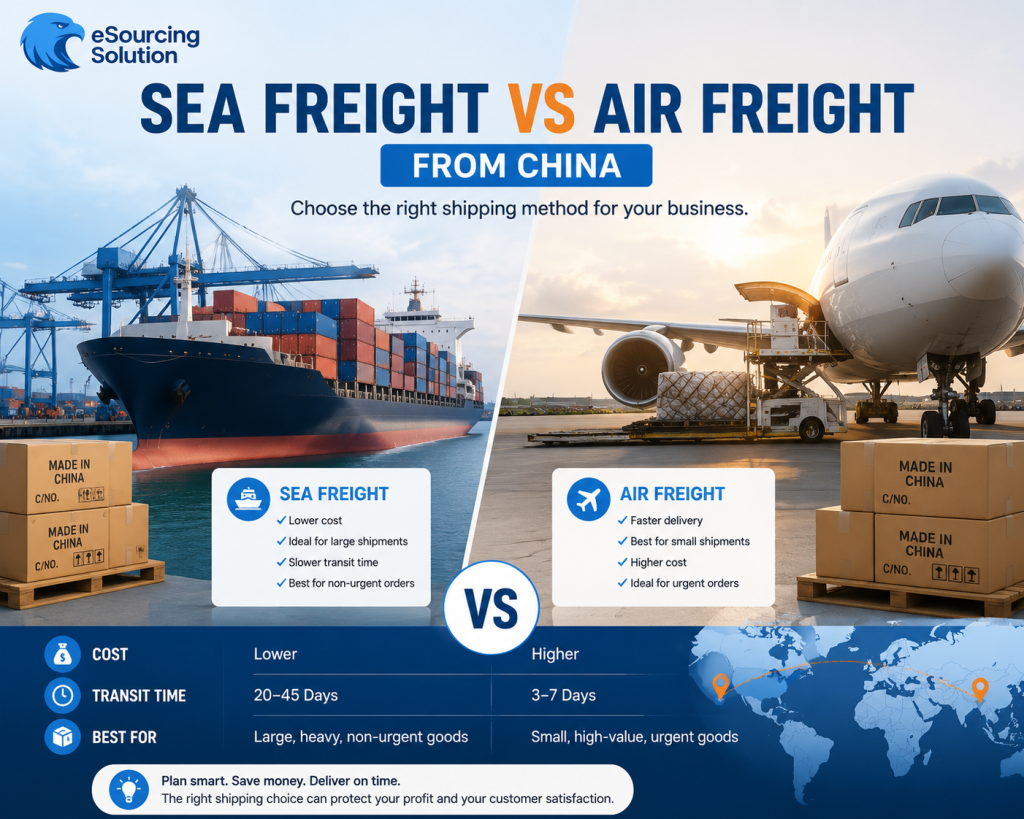
Sea freight moves your goods by container ship. Air freight moves your goods by airplane. That sounds obvious, but the business impact is very different.
Sea freight is usually cheaper but slower. Air freight is usually faster but more expensive. A common mistake is choosing based only on price.
A better question is:
“How much does speed matter for this shipment?”
For example:
A private label seller launching a new Amazon product may need inventory quickly before losing ranking momentum.
A wholesaler ordering 5,000 units of a proven product may prefer lower shipping costs.
Same country. Same supplier. Completely different decision.
Sea Freight From China Explained
Sea freight is the most common option for businesses importing larger quantities from China.
Your products are packed into cartons, loaded into a container, transported to a Chinese port, shipped internationally, cleared through customs, and delivered to your warehouse or Amazon fulfillment center.
There are two common options:
Full Container Load (FCL)
You rent the entire container.
Common container sizes:
- 20-foot container
- 40-foot container
- 40-foot high cube container
FCL usually makes sense for larger shipments.
Less Than Container Load (LCL)
Your goods share container space with other shipments.
LCL works better for smaller orders.
For new Amazon sellers, LCL can be useful because you do not need to wait until you have enough inventory for a full container.
Why Businesses Choose Sea Freight
The biggest advantage is cost.
For large shipments, sea freight usually has a much lower cost per unit compared with air.
This matters when products are:
- Heavy
- Large
- Low margin
- Not time-sensitive
Examples:
- Furniture
- Outdoor equipment
- Bags
- Home products
- Large packaging items
A seller importing 3,000 backpacks usually cannot afford air freight. The shipping cost could destroy the margin. Sea freight allows the product economics to work.
Air Freight From China Explained
Air freight is the faster option.
Instead of waiting weeks for ocean transportation, your goods can often arrive within several days after shipment.
This makes air freight useful for:
- Product testing
- Small inventory
- Urgent restocking
- High-value products
For example:
A supplement brand runs out of inventory two weeks before a major sales event. Waiting for sea freight may mean losing sales.
Air freight costs more. But losing your sales position can cost even more.
Why Businesses Choose Air Freight
Air freight works well when:
You are testing a new product
You do not want to order thousands of units before knowing whether customers actually buy. A smaller air shipment allows you to test demand.
Your product has high value compared with weight
Examples:
- Electronics accessories
- Luxury products
- Specialized equipment
You need speed
Some businesses cannot wait 30 to 45 days for inventory. Speed has value.
Sea Freight vs Air Freight Cost Comparison
There is no fixed shipping price because rates change based on:
- Fuel costs
- Season
- Port congestion
- Destination country
- Product size
- Weight
- Shipping terms
However, the general rule is:
| Factor | Sea Freight | Air Freight |
| Cost per unit | Lower | Higher |
| Speed | Slower | Faster |
| Best for | Large shipments | Small urgent shipments |
| Weight impact | Less sensitive | More sensitive |
| Inventory planning | Requires forecasting | More flexible |
The cheapest shipping option is not always the lowest total cost.
Example:
A seller saves $2,000 by choosing sea freight. But the shipment arrives three weeks late.
During that time:
- Amazon inventory runs low
- Ranking drops
- Advertising becomes less effective
- Customers buy competitors’ products
The cheapest freight option created a bigger business problem.
Sea Freight vs Air Freight Delivery Time
Typical timelines vary, but the general difference looks like this:
Sea Freight
Usually includes:
- Factory preparation
- Trucking to port
- Export customs
- Ocean transit
- Import customs
- Final delivery
The entire process may take several weeks.
Air Freight
Usually includes:
- Factory preparation
- Airport delivery
- Export clearance
- Flight
- Import clearance
- Final delivery
Usually much faster. But remember:
The shipping method is only one part of the timeline.
A factory delay can hurt more than transportation.
We have seen shipments delayed because:
- Packaging was not ready
- Supplier missed production dates
- Documents contained errors
- Inspection found quality problems
Shipping starts after production.
Which Shipping Method Is Better for Amazon FBA Sellers?
Amazon sellers usually need to think differently. Your goal is not just getting products delivered. Your goal is keeping inventory available. A simple approach:
New Product Launch
Air freight may make sense.
Why?
You are testing demand.
You want to avoid ordering too much inventory.
Proven Product
Sea freight usually makes more sense.
Why?
Your sales data is predictable.
Lower shipping costs improve your margin.
Emergency Restock
Air freight can save your listing.
A few hundred units shipped quickly may protect your sales while a larger sea shipment is coming.
Real Sourcing Examples: When Shipping Choices Matter
Example 1: Wrong Product Forecast
A new seller ordered 5,000 units of a kitchen product.
They chose sea freight because it was cheaper.
The problem?
The product did not sell as expected.
They had months of inventory sitting in storage.
The shipping was cheap.
The mistake was ordering too much.
Example 2: Quality Problem Before Shipment
Another seller rushed production and booked shipping immediately.
During inspection, they discovered:
- Incorrect packaging
- Wrong product color
- Missing accessories
The shipment was delayed because the factory needed rework.
The seller blamed shipping.
The real problem happened before shipping.
This is why quality control needs to happen before your goods leave China.
Hidden Costs Beginners Forget
Shipping cost is not only the freight charge.
You may also pay:
- Export documentation fees
- Customs duties
- Port fees
- Warehouse fees
- Amazon receiving fees
- Inspection costs
- Insurance
This is why experienced importers calculate landed cost.
Landed cost includes:
Product cost + shipping + customs + additional fees
Not just the factory price.
Customs Documents You Need When Importing From China
Depending on your product and destination, common documents include:
- Commercial invoice
- Packing list
- Bill of lading
- Air waybill
- Certificate of origin
- Import permits if required
- Product compliance documents
Missing documents can delay customs clearance.
A shipment sitting at the port is expensive.
How Quality Control Affects Shipping Decisions
Many beginners think:
“Once the factory finishes production, I just ship.”
That is risky.
A better process:
Pre-Production Inspection
Confirm:
- Materials
- Specifications
- Packaging
- Production plan
During Production Inspection
Check:
- Product consistency
- Assembly quality
- Manufacturing issues
Pre-Shipment Inspection
Before shipping:
Confirm:
- Quantity
- Product appearance
- Function
- Packaging
Container Loading Inspection
Verify:
- Correct cartons
- Correct labels
- Correct shipment quantity
A cheaper shipping method does not matter if your inventory arrives with quality problems.
Decision Framework: Sea Freight or Air Freight?
| Situation | Recommended Option |
| First product test | Air freight |
| Small inventory order | Air freight or LCL |
| Large proven product | Sea freight |
| Heavy products | Sea freight |
| High-value products | Air freight |
| Amazon stock emergency | Air freight |
| Long-term inventory planning | Sea freight |
| New seller with uncertain demand | Start smaller |
Should You Use a Sourcing Partner?
Shipping problems often start before shipping.
A sourcing partner can help with:
- Supplier selection
- Production monitoring
- Quality inspections
- Shipping coordination
- Documentation checks
This is especially useful for first-time importers who are managing suppliers from another country.
eSourcing Solution helps businesses manage sourcing, supplier communication, and production processes from China.
FAQs
Is sea freight cheaper than air freight from China?
Usually yes, especially for larger shipments. Sea freight generally provides a lower cost per unit, while air freight charges more for speed.
How long does sea freight from China take?
The timeline depends on the destination, port, customs process, and shipping schedule. It usually takes much longer than air freight.
Is air freight worth it for Amazon FBA?
For launches, testing, or emergency inventory, yes. For large regular shipments, sea freight is usually more cost-effective.
Can I combine sea and air freight?
Yes.
Many sellers use a mixed strategy:
Small quantity by air for immediate needs.
Large quantity by sea for lower cost.
What shipping method should beginners use?
Start with your business situation.
If you are testing a product, speed may matter more.
If you already know your sales numbers, lower shipping costs usually matter more.
Final Thoughts
Choosing between sea freight and air freight from China is not about finding the cheapest option.
It is about matching your shipping method to your business stage.
A new Amazon seller testing a product has different needs from an established brand importing thousands of units.
The right decision considers:
- Product value
- Inventory risk
- Cash flow
- Delivery timeline
- Customer demand
Good sourcing is not only finding a factory.
It is making hundreds of small decisions correctly from product development to final delivery.
If that’s you and you want wholesale pricing with real quality checks, you can book a free call and tell us what you’re after, or just reach out here with your product and quantity.