
Long gone are the days when businesses relied on finding the cheapest suppliers. 2026 is all about finding the best overall value for your business. And that is where the strategic sourcing process comes into action. It’s about finding the ideal product quality, delivery times, and long-term sustainable relationships with suppliers. So if you are looking to scale it big by 2027, you need to adopt strategic sourcing.
This guide walks you through the entire 7-step strategic sourcing process in detail, including practical tips so you can optimize your business operations to achieve the best overall value.
What is Strategic Sourcing?
Strategic sourcing is a structured and systematic process of procurement that continuously improves the company’s purchasing activities. Primarily, it’s focused on helping organizations secure cost-effective products and services in the most efficient way. It also takes into account supplier relationships, spending patterns, market risks, and helps optimize the company’s supply chain.
The seven-step strategic sourcing process was first devised by A.T. Kearney in 2001. Since then, businesses have massively adopted it to foster innovation and improve their supply chain operations.
How Strategic Sourcing Relates to Procurement
Strategic sourcing and procurement go hand in hand. Strategic sourcing is about finding the right suppliers, while procurement is about actually buying the products or services and managing the process afterward. Together, they help a business make smarter purchasing decisions while staying within its budget.
For example, sourcing teams may research suppliers, compare prices and quality, negotiate better deals, and choose the best supplier. The procurement team then handles things like placing orders, managing contracts, tracking deliveries, and making sure everything runs smoothly.
When these two functions work together, businesses can spot potential supply problems early, keep suppliers accountable, and save money. Instead of only looking for a supplier when something is urgently needed, companies can plan ahead and build reliable supplier relationships.
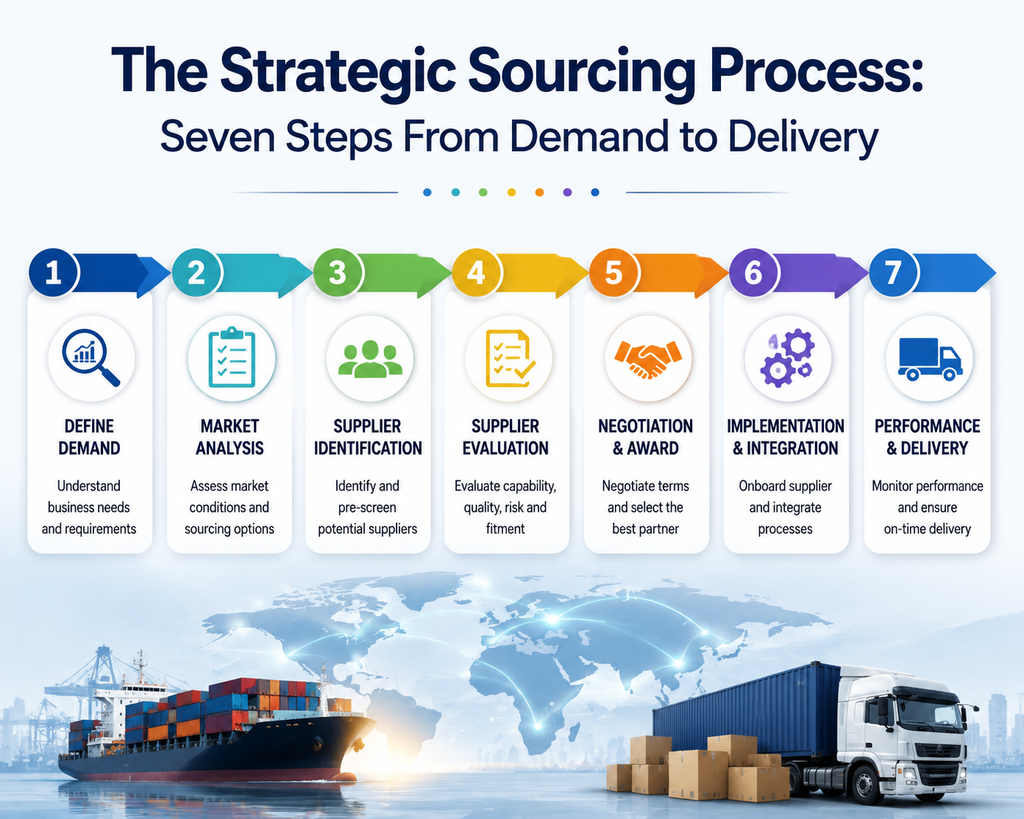
The 7-Step Strategic Sourcing Process in Detail
The following strategic sourcing process is what helps businesses scale their operations. It’s imperative to follow the key objectives highlighted below to achieve results.
- Understand the Spend Category
The first key step is to understand your business’s buying needs. You need to know what you are buying, how much, from whom, and how it helps the business. The spend category is the core foundation, and getting it right essentially means the forthcoming steps are fruitful.
Your organization’s purchase managers need to have answers to the following questions.
- What is the sourcing category?
- What are the characteristics of that category?
- What are the outcomes of our process review?
- Have we inspected and reviewed the marketplace?
- What is the key cost driver?
Purchase managers can get this information by digging into ERP systems and categorizing the data. In 2026, AI automatically cleans and categorizes data within minutes.
- Supply Market Analysis
Next, purchase managers must be aware of the company’s market and the various challenges they face. They need to know how much cost is incurred to produce products at this volume. Who are our major suppliers globally, and how do raw material price fluctuations affect product pricing in the next few months?
Having answers to these questions helps you to understand the power and value of different suppliers and the competition in the market. For global sourcing, also consider risks such as government rules, supply disruptions, and depending too much on one supplier. The more information you have, the stronger your position when negotiating.
- Create a Strategic Sourcing Strategy
Now that you have a better idea of your market and spend category, you need to decide how you can source this. Should you sole-source or multi-source? Once you have a tentative idea, you do the following.
- Determine the appropriate steps and format for the Request for Proposal (RFP), Request for Information (RFI), and Request for Quotation (RFQ).
- Draft the documents.
- Develop a lotting strategy, which covers the combination of goods/services, suppliers, plant/office/region, and volumes.
Make sure the RFPs are well-defined and come with strict specifications.
- Find Suitable Suppliers
Once you have the proposals in hand, you need to search for potential suppliers. To find the best supplier, you need to understand your supplier base by researching the supply market and developing clear assessment criteria based on your business needs. You may hold in-person meetings, request samples, and visit the site to determine the value the supplier may offer.
- Supplier Selection and Negotiation
After receiving supplier proposals, compare them based on price, quality, delivery, experience, and other business needs. Shortlist the best suppliers and negotiate with them to get the best deal.
A team may meet with suppliers several times before making the final choice. It is important to use clear criteria so the best supplier is selected fairly. Good negotiation means being prepared, communicating clearly, staying open to different solutions, and putting the final agreement in writing.
Once terms are agreed, contract drafting and signature close the step. Both parties own what they’ve signed, and the contract becomes the baseline for performance management.
- Finalize Contract and Implement
Once a contract has been signed, it’s important to onboard your new supplier with your business processes and vision. Attention to detail is essential in this agreement. It’s important that the contract aligns with the legal laws and regulations.
The most important step is execution and implementation. Effective execution requires coordination among different teams, stakeholders, and users.
- Track Performance
The last step is benchmarking and checking whether the latest adopted strategy is working. It’s crucial to track supplier performance, cost savings, delivery reliability, and quality metrics. Benchmarking compares realized outcomes against market rates and peer organizations to identify whether contracts are still competitive over time.
Regular communication with suppliers helps businesses find problems early and improve their work. If any issues come up, both sides can work together to fix them and make sure the supplier follows the agreed terms.
Benefits of Strategic Sourcing Process
Strategic sourcing is crucial for businesses these days. Here’s how it benefits the organization.
- Cost savings: By analyzing spend and better supplier negotiation, companies can lower their purchasing costs.
- Increased productivity: Streamlining the procurement process reduces manual time and effort spent on purchasing activities and ultimately increases efficiency.
- Risk mitigation: By diversifying suppliers and continuously monitoring their performance, strategic sourcing helps mitigate risks such as supply chain disruptions, quality issues, and non-compliance with regulatory standards.
- Stronger supplier relationships: Working closely with a few trusted suppliers can build better relationships. This can lead to better service, new ideas, and benefits for both sides.
- Increased agility: A good sourcing strategy helps companies react faster to changes in the market, changes in customer demand, and new business opportunities.
Future Trends in Strategic Sourcing
Strategic sourcing is being greatly impacted by emerging technologies, which offer new capabilities and efficiencies. Data analysis is being revolutionized by artificial intelligence (AI) and machine learning (ML), which allow for deeper insights into market trends, supplier performance, and spending habits.
Procurement teams can now benefit from supply chain agility and inventory visibility thanks to real-time inventory data and demand forecasting. When taken as a whole, these technologies are making strategic sourcing more data-driven, effective, and proactive, allowing companies to better match their procurement procedures with overarching company objectives.
Conclusion
Strategic sourcing helps businesses make better decisions about where and how they buy products and services. From understanding business needs and researching suppliers to negotiating deals and managing supplier relationships, each step helps reduce costs and avoid risks.
When sourcing and procurement work together, businesses can get better quality, reliable delivery, and stronger supplier relationships. A good sourcing strategy is not only about finding the lowest price. It is about finding the right supplier and getting the best value for the business in the long term. If you are looking to source products from China, Book a free consultation or contact eSourcing Solution for exceptional products all across China.
FAQS
What are the 7 steps of strategic sourcing?
The seven steps of the strategic sourcing process are understanding the spend category, analyzing the market, creating a strategic sourcing strategy, finding and selecting suppliers, finalizing the contract, and benchmarking.
What is strategic sourcing?
Strategic sourcing is the process of finding and choosing the right suppliers based on price, quality, reliability, and business needs.
What is the difference between sourcing and procurement?
Sourcing focuses on finding and selecting the right suppliers, while procurement handles the actual purchasing, orders, contracts, and deliveries.
What are the 7 principles of procurement?
The seven core principles of procurement are transparency, fairness, competition, value for money, integrity, accountability, and efficiency