
Why Is AliExpress So Cheap? The Full Breakdown
Why is AliExpress so cheap? This is the first question every new buyer asks when they see a T-shirt for $3, a smartwatch for $9, or a full set of kitchen tools for under $8 with free shipping from China. The prices seem almost impossible when you compare them to Amazon or local retail stores.
AliExpress is a massive cross-border e-commerce platform under Alibaba Group, used by millions of global consumers for its affordable prices and enormous product range. But those low prices aren’t magic. They come from a specific set of economic advantages that Chinese sellers have over Western retailers.
In today’s blog, I’ll analyze the real reasons why AliExpress is so cheap, based on our years of experience in Chinese global sourcing and manufacturing. And I’ll answer the second most common question: is it actually safe to buy there?
Here are the core reasons behind AliExpress’s ultra-low pricing:
- AliExpress connects Chinese sellers directly to global consumers, cutting out middlemen.
- Intense seller competition on the platform pushes prices to rock bottom.
- Many sellers source from overstock markets at below-production costs.
- Small and low-value parcels ship via ultra-cheap cross-border logistics.
- AliExpress Choice provides even cheaper pricing with better service.
Let’s break each one down.
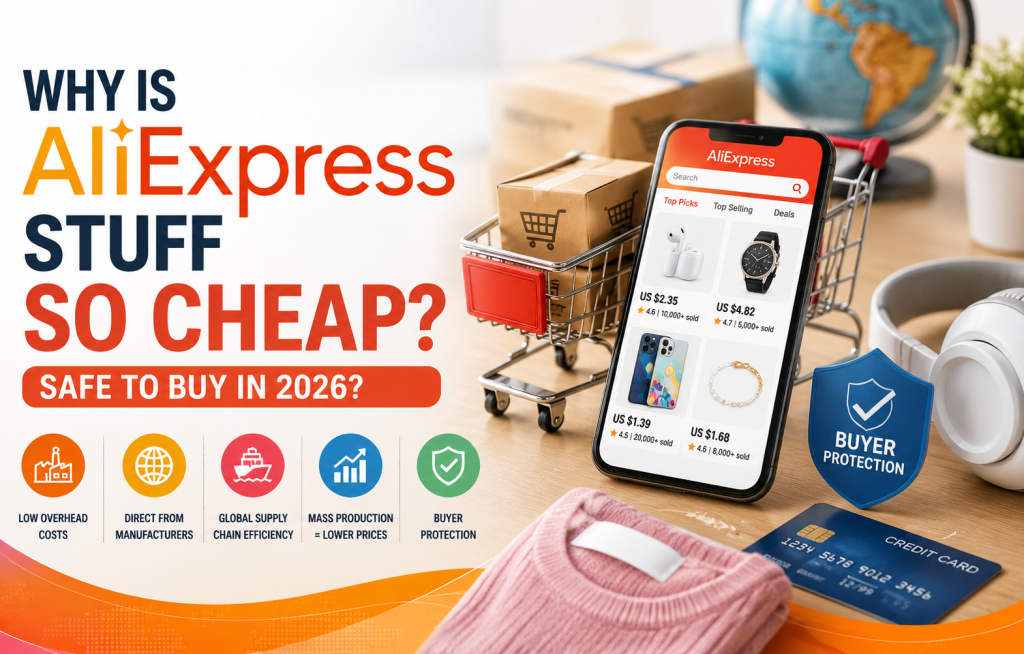
AliExpress Connects Chinese Sellers Directly to Global Consumers
China is still the world’s factory. That’s not just a saying. It’s the fundamental economic reality that explains why AliExpress is so cheap compared to Western retail platforms.
Chinese manufacturing benefits from lower labor costs, mature industrial supply chains, and concentrated supplier ecosystems where raw materials, components, and finished goods production all happen within short distances of each other. All of this keeps manufacturing costs significantly below what factories in the US, Europe, or even Southeast Asia can achieve for most product categories.
AliExpress, as a B2C platform under Alibaba Group, bridges Chinese sellers directly with global consumers. No importers. No distributors. No retail stores adding their margins. The product goes from a Chinese seller’s warehouse straight to your mailbox. This eliminates the 2 to 4 layers of middlemen that typically exist in traditional retail.
Here’s a real example that shows the difference clearly.
Last month I was comparing prices on a stainless steel insulated water bottle. On Amazon US, the price was $24.99 with Prime shipping. On AliExpress, I found what appeared to be the exact same bottle, same capacity, same design, same insulation specs, for $6.80 with free shipping.
Why such a massive gap? Because the Amazon seller likely purchased that bottle from a Chinese factory for $3 to $4 per unit, paid ocean freight, paid US import duties, paid Amazon FBA fees, paid for PPC advertising, and then priced it at $24.99 to cover all those costs plus profit.
The AliExpress seller? Probably the factory itself, or a trader one step removed. Their costs are just manufacturing plus a thin margin plus shipping. No Amazon fees. No US warehouse rent. No import duties on their end.
We see this pattern constantly in our procurement intelligence work. Products that cost $2 to $5 to manufacture in China end up at $20 to $40 on Western retail platforms after all the intermediary costs stack up. On AliExpress, those same products sit at $5 to $10 because the supply chain is compressed to almost nothing.
Many new Amazon sellers actually start by purchasing inventory from AliExpress at low prices, then reselling at higher margins on Amazon or Shopify. It’s one of the most common entry points into e-commerce. The price gap between platforms is literally the business model for thousands of dropshippers and small sellers.
Fierce Seller Competition Drives Prices Even Lower
AliExpress hosts millions of active sellers. For any popular product category, you’ll find dozens, sometimes hundreds, of shops selling essentially identical items. Often sourced from the same factory.
What happens when 80 sellers list the same wireless earbuds? A price war. They undercut each other by cents until margins become paper thin. Some sellers operate on $0.30 to $0.50 profit per order. They survive purely on volume. Sell 300 units daily at $0.40 profit and that’s $120 per day. Enough to sustain a small operation in China where living costs and business overhead are much lower than Western countries.
This hyper-competition benefits buyers enormously. But it also means some sellers cut corners to maintain profitability at those razor-thin margins. Slightly cheaper materials. Less careful packaging. Slower customer service responses. The savings have to come from somewhere when you’re making pennies per sale.
I spoke with an AliExpress seller in Shenzhen last year during a factory visit. He told me his shop listed over 2,000 products but only about 150 of them actually made meaningful profit. The rest were priced at near-zero margin just to generate store traffic and build his rating score. Once customers landed on his shop for a cheap item, some would browse and buy his higher-margin products too. Loss leaders, basically. Same strategy supermarkets use with milk and bread, just applied to cross-border e-commerce.
Overstock and Liquidation Sourcing Keeps Prices Impossibly Low
Here’s something most AliExpress buyers don’t realize. Not everything sold on the platform was manufactured fresh for retail sale.
In Guangzhou, Yiwu, and other major trading cities in China, there are enormous overstock wholesale markets. These markets sell excess inventory from factories that overproduced on orders. Maybe a brand ordered 50,000 t-shirts but only 40,000 passed quality inspection for the original buyer. The remaining 10,000 get sold to overstock dealers at a fraction of production cost. Sometimes literally sold by weight. By the kilogram.
I’ve walked through the overstock floors in Yiwu’s Futian Market. Bins and bins of perfectly usable products, leggings, phone accessories, toys, kitchen gadgets, hair clips, all priced at almost nothing because the factory already got paid by the original buyer and just wants to clear warehouse space.
AliExpress sellers buy from these markets and list items at prices that seem impossibly low. A pair of leggings that cost $3 to manufacture might get sold in overstock for $0.20 per piece. The AliExpress seller lists it at $2.99 with free shipping and still makes profit. To the buyer, it looks like magic pricing. Behind the scenes, it’s just liquidation economics.
This doesn’t mean the products are defective. Most overstock items are perfectly fine. They’re just excess. The factory made too many, or the original buyer cancelled part of an order, or a slight color variation made them unsellable to the brand that ordered them. This is another key reason why AliExpress is so cheap on certain product categories.
Small Parcels Ship Via Ultra-Cheap Cross-Border Logistics
When browsing AliExpress, you’ll notice many small lightweight items priced under $5 with free or near-free shipping. A phone case for $1.50 with free delivery from China to Europe. How does that math work?
China’s cross-border logistics infrastructure is extremely developed. Services like Cainiao Super Economy (Alibaba’s logistics arm), China Post Ordinary Small Packet, and Yanwen Economy offer shipping rates that seem impossibly low for international delivery.
For a small, lightweight item like a phone case or a piece of jewelry, economy shipping from China to most countries costs the seller between $0.30 and $1.50. The trade-off is speed. Economy shipping typically takes 20 to 45 days. Sometimes longer. No tracking on the cheapest options. But for sellers moving thousands of small parcels daily, these rates make sub-$5 pricing viable even with free shipping included.
How do rates get this low?
Volume discounts. High-volume sellers negotiate bulk rates with logistics providers. A seller shipping 2,000 packages daily gets rates that individual shippers could never access.
Postal cooperation agreements. International postal unions have agreements that keep cross-border letter and small packet rates affordable. China Post leverages these agreements extensively for e-commerce parcels.
Consolidated shipping. Logistics companies like Cainiao consolidate thousands of small parcels into bulk shipments, fly them to destination countries, then hand them off to local postal services for last-mile delivery. This hub model is far cheaper than shipping individual packages independently.
Note that economy shipping only applies to small, lightweight general merchandise. Heavier items, electronics with batteries, and higher-value goods require more expensive shipping methods. And each destination country has different rules. For example, the cheapest economy options aren’t always available for US-bound packages due to customs requirements.
For anyone doing product sourcing from China at business volumes, it’s worth understanding that individual parcel shipping through AliExpress is actually more expensive per unit than bulk freight. A sea freight container costs far less per item than thousands of individual air mail parcels. This is one reason why transitioning from AliExpress to direct factory sourcing makes financial sense once your volumes grow.
AliExpress Choice: Even Cheaper With Better Service
AliExpress Choice is a premium service launched in March 2023 that aims to provide even more affordable prices and improved shipping. You’ve probably seen the Choice badge on products while browsing. Items marked with Choice typically offer prices as low as $1 for bundled items, with free shipping over $10 and delivery guarantees around 11 days.
The monthly AliExpress Choice Day shopping events offer additional discounts beyond already-low prices. For buyers in nearly 20 countries including Germany and Switzerland, Choice provides delivery guarantees typically within 10 days. Buyers in over 15 countries including Spain and France get free return services.
What makes Choice products cheaper? AliExpress negotiates directly with sellers and manufacturers to secure lower pricing in exchange for higher visibility and traffic on the platform. Sellers accept thinner margins because Choice placement dramatically increases their order volume. More volume at lower margin per unit can still mean more total profit.
For businesses doing dropshipping, AliExpress Choice brings real advantages. Bigger discounts mean better margins on resale. Faster delivery improves customer satisfaction. Free returns in supported countries reduce your risk as a seller. These services enhance the overall value proposition and help explain further why AliExpress is so cheap compared to alternatives.
AliExpress Products Are So Cheap. Is It Safe to Buy?
This is the question everyone asks after seeing those prices. And I understand the concern. When something costs $3 including international shipping, your brain naturally wonders what’s wrong with it.
Based on our years of experience working with Chinese suppliers and platforms, here’s our honest assessment: the quality of most AliExpress items corresponds to their price. Some even offer excellent value for money. But you need to shop smart.
How to Protect Yourself When Buying on AliExpress
Check product descriptions carefully. Professional sellers provide comprehensive descriptions including specifications, dimensions, materials, and multiple photos from different angles. Vague listings with one blurry image and no specs are red flags. Skip them.
Look at store ratings. Choose sellers with ratings above 95% positive feedback. A store with 4.7 stars over 10,000 orders is generally reliable. A store with 4.2 stars over 50 orders is a gamble not worth taking.
Read buyer reviews with photos. Ignore text-only five-star reviews. Look specifically for reviews where buyers uploaded pictures of what they actually received. This shows you the real product versus the seller’s optimized listing photos. The difference is sometimes dramatic.
Match expectations to price. A $20 watch from AliExpress will not have the same quality, craftsmanship, or durability as a $200 watch. That’s not a scam. That’s just economics. If you spend $5 on a dress and expect department store quality, you’ll be disappointed. If you spend $5 expecting a $5 dress that looks cute in photos, you’ll often be pleasantly surprised.
Always pay through the platform. Never send money directly to a seller via PayPal, bank transfer, or any method outside AliExpress. If a seller asks you to pay off-platform, that’s a scam. Report them and move on.
AliExpress Buyer Protection Actually Works
Your money goes to AliExpress, not directly to the seller. The seller only receives payment after you confirm receipt or after the buyer protection period expires. Your funds are held safely during transit.
If your package doesn’t arrive within the guaranteed delivery window, you get a full refund. No argument needed. The tracking data speaks for itself.
If you receive something significantly different from the listing description, you open a dispute with photo evidence. Describe the issue clearly, upload comparison photos showing the listing versus what arrived. If you and the seller can’t reach agreement, AliExpress mediates. In our experience, they side with buyers when evidence is clear and well-documented.
AliExpress also provides live chat-based customer service agents for order issues. Response quality varies, but having real people available to escalate problems adds a genuine safety layer that protects buyers.
Honest Downsides You Should Know About
Being objective means covering the negatives too. Here’s what the platform doesn’t advertise:
Quality inconsistency between orders. Same product, same seller, different batch can vary noticeably. Without systematic quality control inspection, what you receive depends partly on which production batch your order pulls from.
Sizing chaos for clothing. Chinese sizing runs smaller than Western sizing. Even within AliExpress, sizing varies wildly between sellers because they source from different factories with different patterns. Always check the measurement chart in centimeters. Never trust S/M/L labels alone.
Returns are impractical. You can technically return items. But shipping something back to China costs more than most AliExpress purchases are worth. The dispute system usually offers partial or full refunds without requiring return shipping for low-value items.
Safety and compliance concerns. Products on AliExpress don’t necessarily meet US or EU safety standards. Electronics might lack proper certifications. Children’s products might not meet safety testing requirements. For personal use, assess your own comfort level. For reselling, this becomes a serious legal liability.
Intellectual property issues. Some sellers list counterfeit or knockoff branded products. If a “Nike” shoe costs $12, it’s fake. This creates legal risk if you’re reselling and ethical concerns regardless.
For businesses considering sourcing from AliExpress suppliers at larger volumes, working with a China sourcing agent who can verify factories, enforce specifications, and conduct proper inspections eliminates most of these risks while maintaining competitive pricing.
What’s Changing for AliExpress in 2025-2026
Several shifts worth noting for anyone buying from or competing with AliExpress this year:
De minimis rules tightening. The US and EU are closing customs exemptions that allowed low-value packages to enter duty-free. This means some items will cost more at checkout due to newly applied duties and taxes. Prices are already creeping up 10-15% on some categories compared to 2023.
Temu competition. Pinduoduo’s international platform uses a similar model and is aggressively undercutting AliExpress on many product categories. This benefits buyers through even lower prices but raises questions about long-term sustainability of these pricing levels.
Platform improvements. AliExpress is investing in faster logistics options, better seller vetting, and improved buyer protection to compete with Temu and maintain market share. The shopping experience is gradually improving for buyers worldwide.
AliExpress for Personal Use vs. Business Sourcing
For personal shopping: AliExpress works well for low-risk purchases. Phone accessories, home decor items, craft supplies, tools, hobby materials, trendy fashion pieces you don’t mind experimenting with. Keep individual order values reasonable, read reviews carefully, and you’ll generally have positive experiences.
For testing product ideas: Many successful e-commerce sellers started by ordering small quantities from AliExpress to test whether a product sells before committing to bulk manufacturing. It’s a low-cost way to validate demand with real customers. Order 10 to 20 units, list them on your store, see if they move.
For scaling beyond testing: Once your product validates and your order budget exceeds $500 to $1,000 per product, it’s time to move beyond AliExpress to direct factory sourcing. The same products available on AliExpress can be purchased directly from manufacturers at 30% to 50% lower cost when you order in bulk with proper supplier negotiation.
Having a clear product spec sheet when making this transition ensures you get exactly what sold well during your AliExpress testing phase, not a cheaper substitute the factory decides to send.
The Bottom Line
So why is AliExpress so cheap? Direct access to Chinese manufacturers and sellers with no middlemen. Fierce competition among millions of sellers driving margins to near zero. Ultra-cheap cross-border logistics for small parcels. Overstock inventory sold at below-production-cost prices. Minimal operating overhead. And platform services like AliExpress Choice that negotiate even lower pricing through volume guarantees.
Is it safe to buy? Yes, with reasonable precautions. The platform’s payment protection and dispute system provide genuine buyer safety. You won’t lose money on orders that don’t arrive or items that are completely misrepresented. But “safe” doesn’t mean “guaranteed quality.” Shop smart, read reviews, check seller ratings, and match expectations to price.
For personal purchases and product testing, AliExpress offers genuine value that’s hard to beat anywhere else. For business sourcing beyond the testing phase, direct factory relationships through proper sourcing channels deliver better pricing, better consistency, and actual quality guarantees.
Ready to Move Beyond AliExpress?
When your product sales are going well and your order budget exceeds $1,000, it’s time to source directly from Chinese factories at even lower costs with proper quality oversight.
We are eSourcing Solution, a sourcing company helping businesses connect with verified Chinese manufacturers. Most of our clients are startups and growing sellers on Amazon, Shopify, and other e-commerce platforms who outgrew AliExpress and needed reliable direct sourcing with proper quality control.
We help you quickly match with reliable suppliers, manage product specifications, inspect finished product quality, and arrange transportation to your location. The benefits delivered include factory-direct pricing, consistent quality, faster turnaround, and a supply chain you can actually depend on as you scale.
Book a conversation or send us a message to discuss your product category and sourcing needs. We’ll tell you honestly what’s achievable and what the realistic costs look like for your specific situation.