
Shein’s Low Prices: In-Depth Look and Zara Comparison
Why is Shein so cheap? Let’s discuss in detail. At Shein, you can get a T-shirt for just $6.99, a dress for $7.99, and put together a full outfit from head to toe for under $40. That’s almost half, or even a third, of the price for similar quality products at Zara.
Why are the prices so low on Shein? I’ve been working in Chinese manufacturing and global sourcing for years. I’ve walked through the factory clusters that sew Shein garments. Sat down with workshop owners who fill their orders daily. And I can tell you, the answer isn’t one clever trick. It’s an entire system.
Today, I’ll break down the real reasons objectively and pull out what we small e-commerce businesses can actually learn from their model.
The three pillars behind why Shein is so cheap:
- Built on China’s unrivaled apparel and textile supply chains.
- Small-batch and fast turnaround production model.
- Digitalization spanning the entire Shein supply chain.
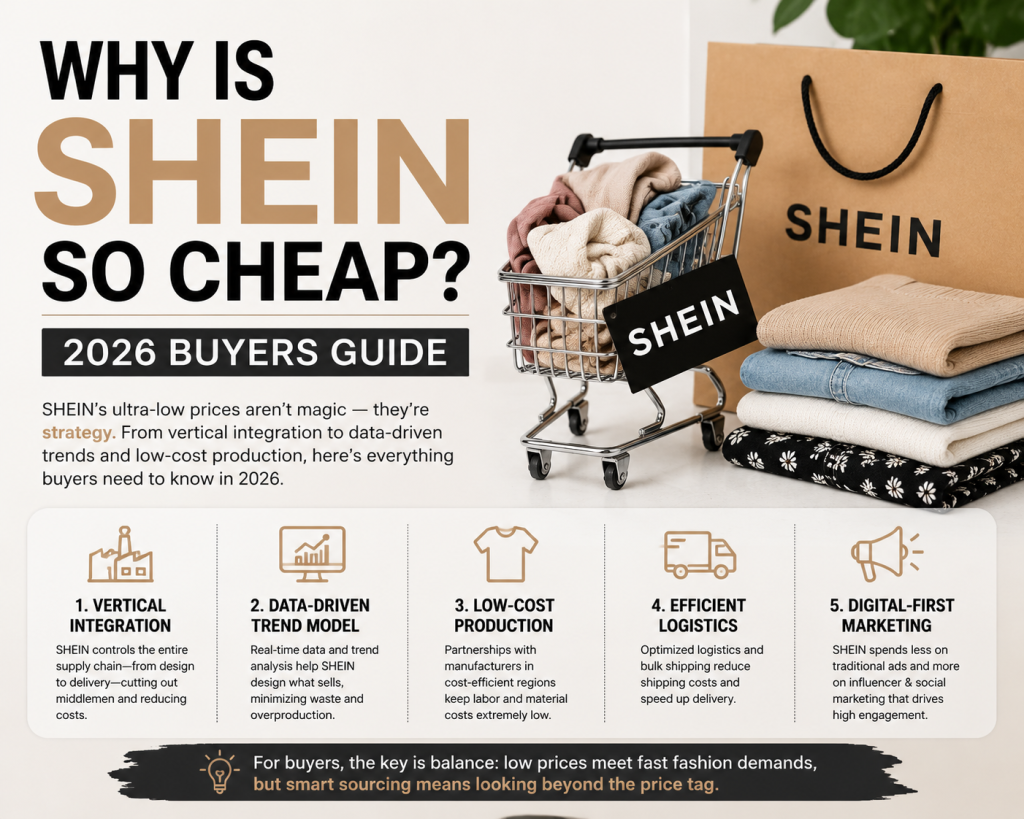
Built on China’s Unrivaled Apparel and Textile Supply Chains
To most US and EU consumers, Shein is a global fashion brand headquartered in Singapore. But it actually started in China, first selling wedding dresses online in 2008 and, by 2012, transitioning to women’s fashion. It’s China’s supply chain that made Shein what it is today.
More specifically, it’s Guangzhou. China’s and the world’s largest clothing wholesale market, combined with massive textile markets and garment factories of every size imaginable.
I remember the first time I drove through Panyu District where Shein’s supply chain center sits. Every other building was a workshop. Fabric deliveries on motorbikes weaving through narrow streets. The constant buzz of sewing machines leaking out of open windows. There’s a cluster of workshops that locals call “Shein Village” because nearly every operation there produces exclusively for them.
Shein’s supply chain center is located right in the middle of this ecosystem. Thousands of clothing factories, most of them small traditional workshops with 20 to 50 workers, perfectly suited to Shein’s small-batch orders and rapid production cycles. Based on skilled craftsmanship and an efficient supply chain system, workers can produce hundreds of garments per day. A speed that overseas factories simply cannot match.
It brings to mind Ford’s legendary Rouge factory a century ago. Or Tesla’s Shanghai Gigafactory today. Concentrated manufacturing power in one geographic zone, optimized for output.
Today, Shein’s supply chain extends beyond Guangzhou to the surrounding Pearl River Delta and the Yangtze River Delta, with around 20,000 factories handling production and supply. They’ve also expanded globally, working with factories in Brazil to serve Brazilian and North American markets, and Turkey for European markets.
But China’s supply chain remains Shein’s backbone. Abundant raw materials. Complete and mature production chains. Skilled and efficient workers. Highly cooperative factories willing to work on tight timelines. These advantages enable Shein to offer ultra-low prices while staying profitable. Something that is genuinely hard to replicate elsewhere.
In contrast, Zara’s core supply chain is in Spain, centered around parent company Inditex’s headquarters. They own many of their production facilities to achieve speed and serve their physical store network. But Spanish labor costs are dramatically higher, and the surrounding supplier ecosystem is far less dense than what exists in Guangdong province.
For anyone exploring procurement intelligence or trying to understand how manufacturing clusters create pricing advantages, Shein’s Guangzhou operation is basically a textbook case study.
Small-Batch and Fast Turnaround Production Model
The model’s core is using small-batch orders to quickly test new products and markets. Based on the vast network of small factories in China, Shein has taken this approach to a level nobody else has matched.
Test Orders as Small as 100 Pieces
For the first order of a new product, Zara requires at least 500 pieces. Shein can start with just 100 to 200 pieces. Sometimes even a few dozen. This allows Shein to minimize the risk of mistakes, since the small order size means any losses are easy to absorb and move on from.
There’s an interesting backstory here that I heard directly from a factory owner in Panyu.
At first, no clothing factory was willing to take on such small orders. The cost of running machines for just one batch wouldn’t even cover setup expenses. To solve this, Shein not only subsidized the factories but also shortened payment terms to one month or even less. That’s dramatically faster than the typical 90-day payment cycle that Chinese brands impose on their suppliers. This helped factories with cash flow, and gradually, more small workshops became willing to collaborate.
I found this fascinating because it shows how Shein essentially trained an entire supplier ecosystem to work differently. They didn’t just find cheap factories. They restructured the economic relationship between brand and manufacturer.
The Math That Changes Everything
With the same 3,000 garments to test the market, Zara can only test 1 to 6 styles. Shein can test up to 30. This gives Shein a dramatically higher chance of identifying a bestseller. Once a product proves popular, they immediately arrange bulk production, adding hundreds or even thousands of pieces based on real market feedback.
This on-demand production model helps Shein significantly reduce inventory costs and waste. Their inventory ratio has dropped to single digits. Far below the textile industry average of 30%. Low inventory means lower warehousing costs, less capital tied up in unsold product, and fewer markdowns on dead stock. All of which contributes directly to Shein’s low consumer prices.
New Product Test Orders Produced Within 7 Days
Shein’s suppliers can complete garment pattern making, samples, and production in just 5 to 7 days. Zara’s fastest production lead time is 14 days. In the traditional mass production model with 5,000 pieces per batch, lead time typically ranges from 30 to 45 days.
Shein releases thousands of new styles daily and launches up to 1.3 million new products each year. Truly “real-time fashion.” In contrast, Zara releases new products twice a week, with around 35,000 new styles annually. What takes Zara a full year, Shein accomplishes in a few weeks.
I’ve seen this speed firsthand. A factory owner showed me an order that came in Monday morning. By Wednesday afternoon, 150 finished pieces were packed and ready for pickup. The whole process from digital tech pack to sealed shipping bag in under 72 hours. That kind of turnaround simply doesn’t exist outside of these Guangzhou clusters.
Digitalization Spans the Entire Shein Supply Chain
Data is integrated throughout Shein’s entire business chain. From initial demand collection and design, through order management and production, with real-time data collection and analysis at every step. This is what ties the whole system together.
Data-Driven Design
Zara is designer-driven. Shein is data-driven. The difference matters more than most people realize.
Shein uses a proprietary tracking system that regularly scrapes data from fashion websites, competitor platforms, social media, and most importantly, their own massive user behavior database. They also work with search engines to track trending keywords and forecast fashion trends. Data from buyers and offline pop-up stores further supports their decisions.
Using big data, Shein analyzes popular colors, patterns, price shifts, and emerging trends. Then instantly shares these insights with the design team to quickly create new style designs. Combined with the small-batch production model, these designs get tested rapidly in the real market.
Compared to the broad and vague “consumer insights” approach that traditional brands rely on, this method is far more specific. It significantly increases the chances of identifying a bestseller before committing serious production resources.
I talked to someone who worked in Shein’s design department briefly. She told me they’d get daily reports showing exactly which search terms were spiking, which competitor styles were getting the most engagement, which colors were trending up or down week over week. The designers weren’t creating from artistic vision. They were responding to data signals in near real-time.
Digitalized Procurement
Shein developed their own digital management system for materials. Everything is clearly organized: the type of fabric needed, the material quantity required per piece and per order, which fabric suppliers can provide it, the price per meter and total cost. All visible, all connected, all updated continuously.
They work with a select group of fabric suppliers who have already passed quality audits. This saves garment factories time dealing with upstream fabric sourcing independently. With the textile market nearby, once an order is placed in the system, fabric can be delivered the next day or even the same day.
Due to their large and stable procurement volume, Shein also has strong bargaining power. They secure better prices from fabric and accessory suppliers than smaller competitors can access. Volume pricing at that scale creates cost advantages that compound across millions of garments.
Digitalized Manufacturing Management
During production, Shein’s system precisely matches orders to the production capacity of different factories. Ensuring maximum efficiency and minimizing idle time. In their partner factories, screens are everywhere. Displaying real-time order information: number of SKUs, production quantities for each SKU, production ratio for each size. Every step of the factory production process and progress updates on the platform continuously.
I saw this myself during a factory visit. A wall-mounted screen showing live data. Which orders were in cutting. Which were in sewing. Which were in finishing. Completion percentages updating every few minutes. The factory owner told me that before Shein’s system, he managed everything on paper and WhatsApp messages. Now everything flows through the platform automatically.
This refined digital management allows information to flow like blood through every part of the supply chain. Boosting efficiency at each stage. The value created here gets passed down to end consumers as endless fashion products, constantly rotating new styles, all available at affordable prices.
No Physical Stores. Maximum Cost Efficiency.
Shein primarily sells through their online website and mobile app. They have just one permanent physical store in Tokyo’s Harajuku district and some pop-up shops, usually lasting 3 days, in major cities across the EU and US.
These pop-up shops typically don’t sell products directly. They serve as showrooms, offering fitting services, and feature Instagram-worthy spots to encourage influencers and consumers to share and promote Shein items on social media. Brilliant marketing at minimal cost.
This approach contrasts sharply with Zara, which invests heavily in its physical store network of 1,900+ locations worldwide. Each store requires premium retail rent, staff, utilities, fixtures, security, and constant inventory management. By saving on these massive overhead costs, Shein can offer lower prices while remaining competitive.
Their marketing model follows the same efficiency logic. Instead of expensive TV campaigns or magazine spreads, Shein sends free products to micro-influencers who create organic content. A $30 package of free clothes generates social media posts reaching thousands of potential buyers. The cost-per-acquisition through this approach is a fraction of traditional fashion advertising.
Shein vs Zara: Direct Comparison
| Factor | Shein | Zara |
| Minimum test order | 100-200 pieces | 500+ pieces |
| Design to sale timeline | 3-7 days | 14-25 days |
| New styles per year | ~1.3 million | ~35,000 |
| Inventory ratio | Single digits (%) | ~15-20% |
| Supply chain center | Guangzhou, China | Arteixo, Spain |
| Number of suppliers | ~20,000 factories | ~1,800 suppliers |
| Physical stores | 1 (+ pop-ups) | 1,900+ |
| Design approach | Data/algorithm-driven | Designer-driven |
| Payment terms to suppliers | 30 days or less | Industry standard (60-90 days) |
| Primary sales channel | App/website only | Stores + online |
Both companies are fast fashion. But they’re playing completely different games with completely different cost structures.
What Changed for Shein in 2025-2026
Several shifts worth noting for anyone buying from or competing with Shein this year:
De minimis loophole tightening. US and EU legislation is closing the customs exemptions that let Shein ship individual packages duty-free. Prices have already crept up 10-20% on some items compared to 2023 levels.
Temu competition. Pinduoduo’s international platform uses a similar direct-from-China model and is aggressively fighting for the same customers. This price war benefits buyers short-term but raises sustainability questions.
EU fast fashion regulations. France passed legislation targeting ultra-fast fashion with environmental surcharges. More EU countries are following. Compliance adds cost.
Global supply chain expansion. Shein is building supplier relationships in Turkey and Brazil to reduce shipping times and navigate trade restrictions. Diversification adds operational cost but improves regional delivery speed.
What Small E-Commerce Businesses Can Learn From Shein
Here’s the key takeaway. Becoming an industry giant like Shein is incredibly challenging for small businesses. But there’s so much we can learn from their model.
The future of e-commerce competition boils down to three things:
Product selection. If you don’t get this right, no amount of marketing effort will matter. All of our most successful clients at eSourcing Solution got their product selection right from the start. That alone gave them a 70% head start. Why? Because today’s marketing strategies and traffic costs are transparent. Everyone knows how Facebook ads and TikTok shops work. The real competition lies in who picks better products.
Low-cost testing and rapid iteration. You don’t need Shein’s scale to apply their testing philosophy. Start with 200 to 500 units instead of 5,000. Validate demand with real sales data before committing serious capital. A China sourcing agent can help you find factories willing to accept smaller initial orders with reasonable minimums.
Maintaining supply chain advantages. Once you identify a winning product, everything depends on your supply chain. Can you reorder quickly when stock runs low? Can you maintain consistent quality as you scale? Can you improve the product based on customer feedback without starting from scratch? Supplier negotiation and cost optimization becomes critical at this stage.
The factories Shein uses are available to independent brands too. Same regions. Same capabilities. Same speed potential. The difference is oversight and relationship management. When you source through proper channels with quality control and clear product specifications, you get competitive pricing without the quality inconsistency that Shein customers experience.
For brands looking to source products from China with strong economics and actual consistency, the manufacturing infrastructure exists. The question is whether you have the right sourcing partner managing the process.
Applying This to Your Business
Why is Shein so cheap? Three systems working together. China’s unmatched manufacturing ecosystem concentrated in Guangzhou. A small-batch, data-driven production model that eliminates inventory waste. And end-to-end digitalization connecting every step from trend detection to delivery.
You can’t replicate all of this at their scale. But you can apply the principles. Test small. Let data guide your decisions. Build strong supplier relationships. Control your supply chain. And invest in procurement outsourcing or sourcing support that gives you access to the same manufacturing ecosystem without needing to manage 20,000 factories yourself.
The benefits delivered by working with a professional sourcing partner include factory-direct pricing, quality enforcement, faster turnaround, and the ability to test products at lower minimums. Exactly the advantages that power Shein’s model, adapted for independent brands and small businesses.
At eSourcing Solution, we understand this challenge. With millions of suppliers in China and countless small business owners seeking the right match, our mission is straightforward. We connect you with verified factories, monitor and handle the entire sourcing process from samples to quality control, so you can build a strong, steady, competitive, and efficient supply chain.
Ready to explore what this looks like for your specific product? Book a conversation or reach out here. We’ll talk through your category, your volume, and what’s realistically achievable.