
If you import from China, one of the first questions you hit is not “which factory?” but “which province?” I get this question more than almost any other, and I think it deserves more attention than it gets. Pick the right region and a lot of sourcing problems never show up. Pick the wrong one and even a decent supplier will struggle to give you what you need.
This guide breaks down Guangdong vs. Zhejiang vs. Jiangsu in plain terms. I’ll tell you what each region is good at, where it falls short, and how I would match a product to a province if it were my money on the line.
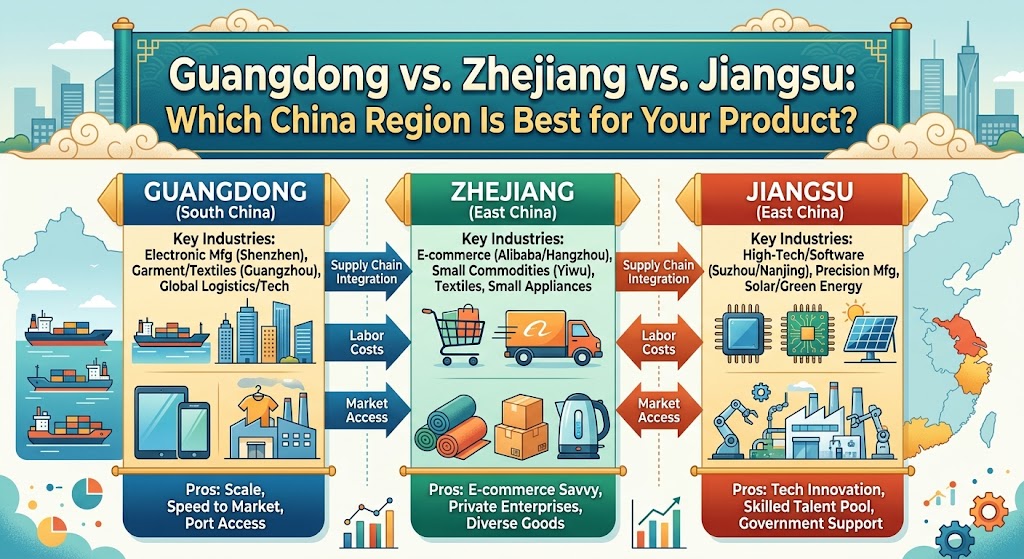
Why Region Matters More Than Most Buyers Think
China does not make everything everywhere. Factories cluster. One town makes socks, another makes lighting, another makes machine tools. Over time, each cluster builds its own network of material suppliers, mold shops, packaging firms, and skilled workers.
That is good news for you. When you source in the right cluster, you get:
- Lower costs, because materials and parts are close by
- Faster samples and shorter lead times
- More factories to compare in one trip or one video call
- Suppliers who already know your product and its quality rules
Maple Sourcing makes the same point: buying from the wrong region can mean higher costs, uneven quality, and logistics headaches. And the stakes are big. The Yangtze River Delta, which includes Shanghai, Jiangsu, and Zhejiang, accounts for roughly a quarter of China’s GDP, while Guangdong sits at the center of the Pearl River Delta, long known as the world’s workshop.
Learn more about the differences between a trading company and a factory here.
Guangdong vs. Zhejiang vs. Jiangsu at a Glance
Here is the quick view before we go deeper. These are general patterns, and individual factories will vary.
| Factor | Guangdong | Zhejiang | Jiangsu |
| Known for | Electronics, appliances, furniture, lighting, apparel | Small goods, hardware, textiles, daily-use items | Precision parts, machinery, laptops, home textiles |
| Typical buyer | Brands needing custom or tech products | Small and mid-size sellers, multi-category buyers | Industrial buyers, long-term quality-focused buyers |
| MOQ | Medium to high, some flexibility | Often lower and more flexible | Often higher |
| Speed | Very fast prototyping | Fast supplier matching | Slower but steadier |
| Price level | Competitive | Very competitive | Slightly higher |
| Quality systems | Strong in OEM/ODM hubs | Varies by city and factory | Often more standardized |
| Main ports | Shenzhen, Guangzhou | Ningbo (and Shanghai nearby) | Shanghai (and Nanjing, Suzhou area) |
Guangdong: Speed, Tech, and Big Product Variety
When a buyer tells me they are building a new electronic product, Guangdong is where the conversation starts. Shenzhen is the headline city. If a product has a circuit board, battery, or screen, there is a good chance its design and production trace back there. According to Maple Sourcing, you can often get a sample of a new electronic device within weeks, not months, because the whole ecosystem is built for fast prototyping. Industry data compiled by Wedoimport also shows that about a third (33%) of China’s electronics industry sits in Guangdong.
But Guangdong is much more than Shenzhen. Here is how I think about its main cities:
- Shenzhen: Consumer electronics, smart devices, LED products. Best for startups and tech brands that want fast development and OEM or ODM support.
- Guangzhou: Apparel, bags, leather goods, cosmetics, and the Canton Fair. Strong for fashion and beauty buyers.
- Dongguan: Plastics, molds, toys, furniture, and knitwear. A real production city with large capacity.
- Foshan: Furniture, ceramics, building materials, and home appliances. WorldFirst’s Foshan profile says Foshan produces 50 to 75 percent of all furniture made in China and about 54 percent of China’s ceramic tile.
- Zhongshan: Lighting, locks, and small appliances. WorldFirst’s Zhongshan profile says around 70 percent of China’s lighting is made in Guzhen, a town in the Zhongshan area.
Where Guangdong works best: electronics, lighting, furniture, ceramics, home appliances, and anything custom that needs quick design changes.
Where it can be tricky: The market is crowded. Maple Sourcing warns that you can find good suppliers in a sea of trading companies and factories of mixed quality, so audits are not optional here. Also, if you buy many unrelated products, you may end up coordinating several cities.
Zhejiang: Flexible Orders and Small-Goods Heaven
Zhejiang is where I send many first-time buyers, and for a good reason. It is the home of the small-business spirit in China. Entire cities specialize in one product, and many suppliers will work with lower MOQs than you would get elsewhere. Union Home calls it one of the easiest regions for new buyers to start in, especially for small and mid-size businesses, online sellers, and anyone sourcing across multiple categories.
The cities I would know first:
- Yiwu: The world’s biggest small-commodities market. Gifts, accessories, toys, holiday items, and household goods. Low MOQs and a huge range. One thing to know, per Maple Sourcing: Yiwu is mostly full of middlemen and trading agents, so it helps to build a relationship with someone reliable who can consolidate orders and check quality.
- Ningbo: Small appliances, plastics, stationery, auto parts, and a major export port.
- Hangzhou: Fashion, apparel, and online-driven brands.
- Shaoxing: Fabrics and curtains.
- Yongkang: Often called the hardware capital. One sourcing guide counts more than 30,000 hardware-related suppliers and over 10,000 product categories in the city, covering power tools, hand tools, garden tools, and more.
- Smaller specialty towns: Zhuji for socks, Pinghu for luggage, Wenzhou for shoes, glasses, and electrical switches.
Something else worth knowing: the map is changing. A Zhejiang hardware insider noted on LinkedIn that two decades ago more than 80 percent of China’s kitchenware manufacturing was in Guangdong, but Zhejiang has since built a world-class hardware cluster, and Yongkang now makes a very large share of the world’s insulated tumblers. Regions move, so check where your product is made today, not where it was made ten years ago.
Where Zhejiang works best: multi-category sourcing, small to mid-size orders, hardware, daily-use goods, textiles, socks, luggage, and e-commerce products.
Where it can be tricky: Quality varies a lot from factory to factory, and Yiwu has many intermediaries. Good checks and clear specs matter more here than in the high-end clusters.
Jiangsu: Precision, Industry, and Steady Quality
Jiangsu is the province I look at when a buyer says “consistency” more than “cheap.” It is one of China’s wealthiest provinces and sits right next to Shanghai, the busiest container port in the world, which is great for export logistics.
The main cities:
- Suzhou: Electronics, precision components, laptops and computer peripherals, fine chemicals, and textiles. The Suzhou Industrial Park hosts hundreds of Fortune 500 companies.
- Wuxi: Machinery, industrial automation, electric motors, and renewable energy parts like solar and wind components.
- Nantong: A leading home textiles base for bedding, towels, and home fabrics.
- Changzhou: New energy and automotive parts.
- Danyang: A major base for drilling and cutting tools, especially HSS drill bits, per a Jing Sourcing guide.
Wedoimport’s cluster data also shows Jiangsu holds about 20 percent of China’s textile industry, with Zhejiang close behind at about 18 percent.
Jiangsu suppliers are often used to demanding international clients. As Maple Sourcing puts it, that tends to translate into better quality control systems and more professional communication. The tradeoff, as Union Home notes, is that prices can be slightly higher than in other regions. In my view, if your product has tight tolerances or you plan a long-term supply deal, that extra cost often pays for itself.
Where Jiangsu works best: machinery, industrial parts, precision components, home textiles, new energy products, and any product where one bad batch would hurt your business.
Where it can be tricky: Higher MOQs and less flexibility for small test orders. It is not the best place for an unproven product or a tiny first run.
Match Your Product to the Region
This is the part most buyers want, so here is a simple cheat sheet:
| If you are sourcing… | Start with… | Why |
| Consumer electronics, smart devices | Guangdong (Shenzhen) | Fastest prototyping and the deepest parts supply |
| Lighting, furniture, ceramics, kitchen appliances | Guangdong (Zhongshan, Foshan) | Large, specialized clusters |
| Gifts, accessories, toys, party items | Zhejiang (Yiwu) | Huge variety and low MOQs |
| Hand tools, power tools, drinkware | Zhejiang (Yongkang) | Massive hardware cluster |
| Socks, luggage, small appliances | Zhejiang (Zhuji, Pinghu, Ningbo) | Town-level specialization |
| Machinery, motors, automation | Jiangsu (Wuxi) | Engineering depth |
| Precision parts, laptops, components | Jiangsu (Suzhou) | Standardized, export-ready factories |
| Bedding, towels, home textiles | Jiangsu (Nantong) | Leading home textile base |
| Cutting tools, drill bits | Jiangsu (Danyang) | Focused tool cluster |
How I Would Choose Between the Three
When someone asks me for the best region for their product, I walk through four questions:
- What exactly is the product? Be specific. “Kitchen product” is too loose. “Stainless steel insulated bottle” points straight to a cluster.
- How big is your first order? Small test runs fit Zhejiang best. Medium and large runs fit Guangdong. Large, repeat, quality-critical runs fit Jiangsu.
- How much customization do you need? Heavy custom work usually starts in Guangdong. Standard products can come from anywhere.
- How much does consistency matter? The more a defect would hurt you, the more I lean toward the factories with stronger systems, which is often Jiangsu or the top OEM factories in Guangdong.
Then I shortlist three to five factories in the chosen cluster, not one. Compare quotes, sample quality, and how fast and clearly they answer questions.
Mistakes I See Buyers Make
- Choosing a region by price alone. The cheapest quote in the wrong cluster often means weak materials or no real production experience with your product.
- Mixing too many products in one region. If you buy lighting, socks, and tools, you may need three regions. Plan for it.
- Skipping factory checks because “everyone sources here.” A famous city does not guarantee a good factory. Verify the business licence, run an audit, and test samples.
- Ignoring shipping. Your port matters. Shenzhen, Ningbo, and Shanghai each serve different clusters.
- Trusting old information. Industries move between provinces. Check the current picture.
Conclusion
There is no single winner in Guangdong vs. Zhejiang vs. Jiangsu. Guangdong is the pick for fast product development, electronics, lighting, and furniture. Zhejiang is the pick for variety, flexible MOQs, and small goods. Jiangsu is the pick for precision, industrial products, and steady quality over the long run.
The right choice comes down to your product, your order size, and how much risk you can take. Start by matching your product to its home cluster, shortlist several factories, check them properly, and test samples before you commit. Do that, and the region will work for you instead of against you.
If you are not sure which province fits your product, we can help. At eSourcingSolution, we match your product to the right region, find and verify the factories, and manage quality from sample to shipment. Talk to our team and tell us what you want to source. We’ll help you pick the right region and the right supplier the first time.
Frequently Asked Questions
Which is better for sourcing, Guangdong, Zhejiang, or Jiangsu?
It depends on your product. Guangdong is strongest for electronics, lighting, and furniture. Zhejiang suits small goods, hardware, and flexible orders. Jiangsu fits machinery, precision parts, and home textiles.
Which region has the lowest MOQs?
Zhejiang, especially Yiwu, is known for low MOQs and a wide range of products, which is why many small businesses and online sellers start there. Jiangsu tends to have higher MOQs.
Is Jiangsu more expensive than Guangdong or Zhejiang?
Often slightly, yes. The higher price usually comes with more standardized processes and consistent quality, which can lower your defect and rework costs over time.
Where should I source electronics in China?
Shenzhen in Guangdong is the main hub for consumer electronics and smart devices. Suzhou in Jiangsu is a strong option for precision components and computer products.
Can I source from more than one region at once?
Yes, many buyers do. Just plan for extra coordination. A sourcing partner can consolidate shipments, manage quality across suppliers, and keep your timelines on track.