
You found a supplier with a clean website, fast English replies, and a marketplace profile that says “manufacturer.” You are ready to send a deposit. But is this actually the factory that will make your product, or a middleman who will place your order with someone you have never met?
The trading company vs. factory question catches a lot of business owners off guard. It is one of the most common and expensive mistakes in China sourcing, and it is easy to avoid once you know what to look for. This guide shows you how to tell the two apart, when each one is the right choice, and how to check before your money moves.
Why This Matters to Your Bottom Line
Knowing who you are buying from affects price, minimum order sizes, quality control, and how much leverage you have if something goes wrong.
Start with price. According to Advanta Sourcing, a trading company usually charges 5 to 30 percent more than a factory, depending on the product. That sounds small until you do the math. On a $5 product with a 20 percent margin, you pay $1 extra per unit. At 10,000 units a month, that is about $120,000 a year leaving your business.
Then there is the bigger picture. ChinaMakersHub points out that a large share of suppliers calling themselves manufacturers on B2B platforms are really trading companies. That is not automatically bad. The real mistake is paying a middleman margin without knowing you are doing it.
What Is a Factory?
A factory is a registered company that owns or runs a physical production site. It has the machines, hires the workers, buys the raw materials, and ships the goods. Its Chinese business licence (营业执照) lists manufacturing (制造 or 生产) in the approved business scope.
The upside for you is clear. You get factory-direct pricing, a view into production, and a clear party to hold responsible when something fails.
The catch is that most factories specialize. A plant that makes stainless steel kitchenware will not also make electronics or plastic parts. If you buy across several categories, one factory will not cover it.
What Is a Trading Company?
A trading company buys from factories and sells to you with a margin on top. Its licence usually mentions trading (贸易), import and export (进出口), or distribution rather than manufacturing.
These companies often have strong English, big catalogs, and good export experience. They can pull goods from several factories into one shipment. The key point is that they do not control production. When you place an order with them, they place another order downstream. Your quality, lead time, and specs depend on how good their factory relationships are.
Read more on how to vet a Chinese manufacturer here.
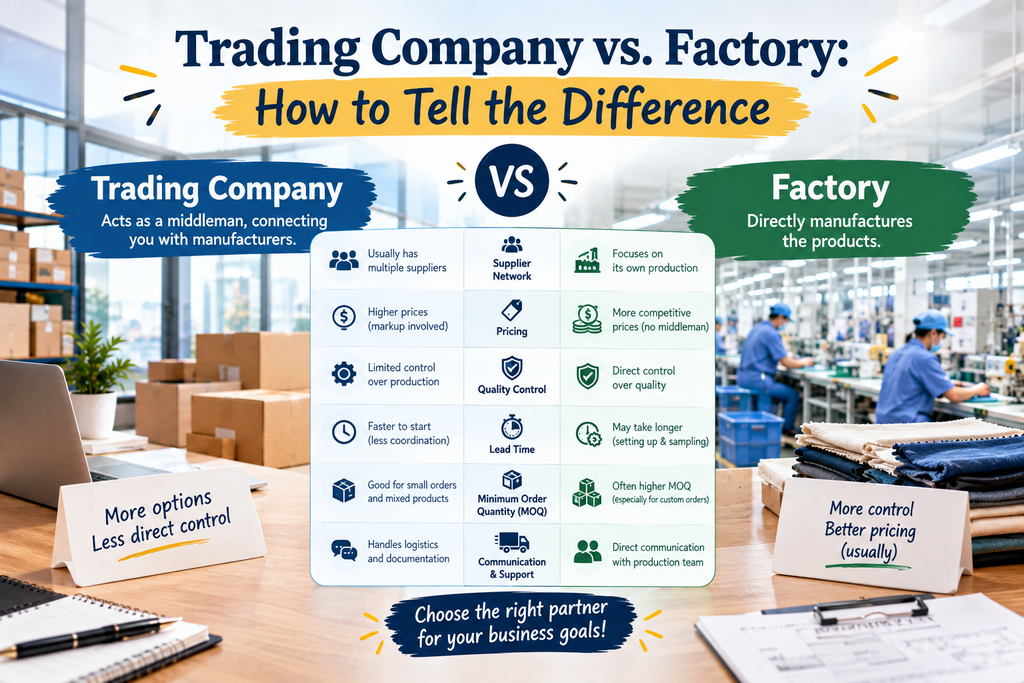
Trading Company vs. Factory: Side-by-Side
Here is a quick comparison based on typical patterns. Individual suppliers will vary.
| Factor | Factory | Trading Company |
| Unit price | Lower, no middleman margin | Usually 5 to 30% higher |
| MOQ | Often higher, tied to production runs | Often more flexible |
| Production control | Direct | Indirect |
| Communication | May need translation help | Usually strong English |
| Quality oversight | Full access to the floor | Limited, depends on their factories |
| Custom development | Direct tooling and R&D | Limited, needs factory buy-in |
| IP protection | Stronger if the deal is with the maker | Weaker, your designs travel to unknown factories |
| Dispute handling | Clear accountability | Risk of blame passing between trader and factory |
When a Trading Company Is the Smart Choice
Please do not walk away thinking trading companies are the enemy. In the right situation they save you real time and trouble.
- You buy across many categories. One trader with good relationships can cover furniture, accessories, and apparel. Managing three factories in three provinces is a lot of work.
- Your volumes are small. Early-stage businesses often miss the MOQ of a direct factory. A trader who combines orders from several buyers can make small runs possible.
- You need language and export help. If you have no one on your team who can deal with factories directly, a trader’s English and paperwork skills are worth paying for.
The honest question is not “is this a trading company?” It is “does this trading company give me more value than it costs me?”
When You Should Go Direct to the Factory
Some jobs need you to deal with the maker.
- Custom tooling and product development. Mold ownership, tooling agreements, and IP terms must be signed with the company that actually holds the equipment.
- Products with sensitive designs. Every extra hand that touches your specs is another leak risk. A trader plus a factory plus possibly a competitor’s order in the same plant is a lot of exposure.
- High repeat volume. Once a product is proven and you reorder at scale, the trader’s margin gets expensive and is easy to cut out.
- Technical products. Tight tolerances and ongoing engineering talks work better without a go-between.
How to Tell: Signs You Are Talking to a Trading Company
No single sign proves anything. Look for a pattern. These are the clues that show up most often across industry guides:
- The catalog is huge and unrelated. Furniture, cosmetics, and electronics from one “factory” is a bad sign. SourceReady notes there is an exception for large industrial groups that own several plants, so check ownership before you decide.
- The website sells products, not production. Real factories like to show off machines, workshops, and processes. Traders talk about “our supplier network.”
- Technical answers are slow or vague. If every detailed question needs “checking with the factory,” you are probably talking to a go-between.
- The licence says trade, not manufacturing. This is the strongest paper clue.
- The address is an office tower. Factories sit in industrial zones, not city-centre high-rises.
- They dodge factory visits. If they offer to take you to a “partner factory” instead of their own line, take note.
- Prices change a lot between quotes. Traders often need to collect new quotes from their factories, which can show up as slow replies and shifting numbers.
One question works better than most: “Can I visit the production line, and is it at the address on your business licence?” A real factory says yes and gives you a date. A trader hesitates or changes the subject.
A Simple Verification Process
Do not rely on one check. Build a case with several. Here is a routine you can follow before any deposit.
| Step | What to Do | What to Look For |
| 1 | Ask for the business licence | Business scope should say manufacturing (制造 or 生产), not only trading or sales |
| 2 | Check the registered address | Use Baidu Maps or Google Maps. It should show an industrial site |
| 3 | Look at registered capital and age | Very low capital and a brand-new registration deserve caution |
| 4 | Request an equipment and capacity list | Real factories give exact machine types, numbers, and monthly output |
| 5 | Do a live video walkthrough | Live, not pre-recorded. Ask questions as you go |
| 6 | Check export history | Trade data tools like Panjiva or ImportGenius show shipment records |
| 7 | Verify certificates | Contact the issuing body directly |
| 8 | Match the bank account name | It must be exactly the company name on the licence |
| 9 | Inspect samples | Never skip this with a new supplier |
| 10 | Look up the company officially | Search by credit code on China’s National Enterprise Credit Information Publicity System |
If you are doing bigger orders, a half-day factory audit will show things emails never will, like real capacity, number of workers, machine condition, and whether quality systems exist outside of PowerPoint.
Watch Out for Hybrid Suppliers
Real life is messier than a clean either-or. Many established factories run a separate trading company to handle overseas sales while the parent factory does the production. You might sign with the trading arm even though the same group owns the plant. That can be fine if you get access to the factory team, and annoying if the trading arm acts as a wall.
Another case is a factory that makes its main product in-house but outsources some parts, or even large parts of your order, to sub-contractors you have never seen. That is common everywhere, but it becomes a problem when you do not know about it.
So ask the question per product, not per company: for the item I am buying, does this supplier make it or buy it? And put the answer in your contract.
Red Flags: Stop and Dig Deeper
If you see more than two of these with one supplier, slow down:
- They refuse or delay sharing the business licence
- The licence shows only trading or sales
- The bank account name does not match the company name
- The registered address is an office building
- Prices sit far below the market with no clear reason
- Their story about capacity or location keeps changing
- Factory photos look like stock images (try a reverse image search)
- No export history shows up for their main product
- They resist audits or inspections
- The certificate issuer cannot confirm the certificate
A low price alone does not prove factory-direct supply. Trading companies often cut prices to win business.
Final Thoughts
The trading company vs. factory question is not about good and bad. It is about knowing exactly who you are paying and why. A factory gives you lower prices, closer control, and stronger protection for your designs. A trading company gives you flexibility, easier communication, and one contact for many products. Both are fine when you choose with open eyes.
Before you commit, check the business licence, match the names, confirm the address, ask for a live factory walkthrough, and verify certificates and export history. One check is not enough, but several together will tell you the truth. If your product is custom, sensitive, or ordered in large volume, aim for the factory. If you buy small or across many categories, a trusted trader may be the smarter choice.
Do not want to run all these checks on your own? That is what we do. At eSourcingSolution, we find and verify real manufacturers, so you know exactly who is making your product before your money leaves your account. Visit esourcingsolution.com and tell us what you need to source. We will take it from there.
Frequently Asked Questions
How do I know if a Chinese supplier is a factory or a trading company?
Start with the business licence and read the business scope. Then check the registered address on a map, ask for an equipment and capacity list, and request a live video tour. Real factories answer these requests quickly and in detail.
Is a trading company more expensive than a factory?
Usually yes, by about 5 to 30 percent depending on the product. But a trader can still be the better deal if it gives you lower MOQs, combined shipments, or multi-category sourcing that would otherwise need several factory relationships.
Are trading companies risky?
They add extra layers, which can mean weaker quality accountability and more IP exposure. The risk is manageable with proper checks and a solid contract. It becomes a real problem only when you do not know you are dealing with a trader.
Can a trading company make custom products?
Not on its own. It can arrange custom production through a factory, but your control over tooling ownership, specs, and IP is weaker. For heavy customization, go direct to the manufacturer.
How do I check a Chinese business licence?
Ask the supplier for a clear copy. Read the company name, registered address, business scope, registered capital, and validity period. Then confirm it using the company's unified social credit code on China's official enterprise credit system.