
The biggest Chinese supplier red flags when choosing one include suspiciously low prices, unverifiable business details, pressure to pay quickly, requests for payment to personal bank accounts, fake product certifications, and refusal to allow independent quality inspections. These warning signs do not always prove fraud, but they should make buyers stop and investigate before sending money.
China remains an important sourcing destination for importers, wholesalers, retailers, and manufacturers. Businesses can find a wide range of products, competitive production costs, and suppliers with experience in international trade. However, a supplier’s online profile, attractive quotation, or professional communication does not automatically mean the business is reliable.
The problem is that some scams only become clear after the buyer has paid a deposit. In other cases, the supplier is a real company but delivers poor-quality products, misses deadlines, or changes the agreed terms.
For example, a buyer may receive a sample that looks perfect, approve a large order, and later discover that the bulk shipment uses cheaper materials. Another buyer may believe they are paying a factory but unknowingly transfer money to an unrelated trading company.
The good news is that many of these risks can be reduced through proper supplier verification, clear contracts, and independent quality checks.
In this guide, we explain the main warning signs, common China sourcing scams, and practical steps businesses can take to protect their money and supply chains.
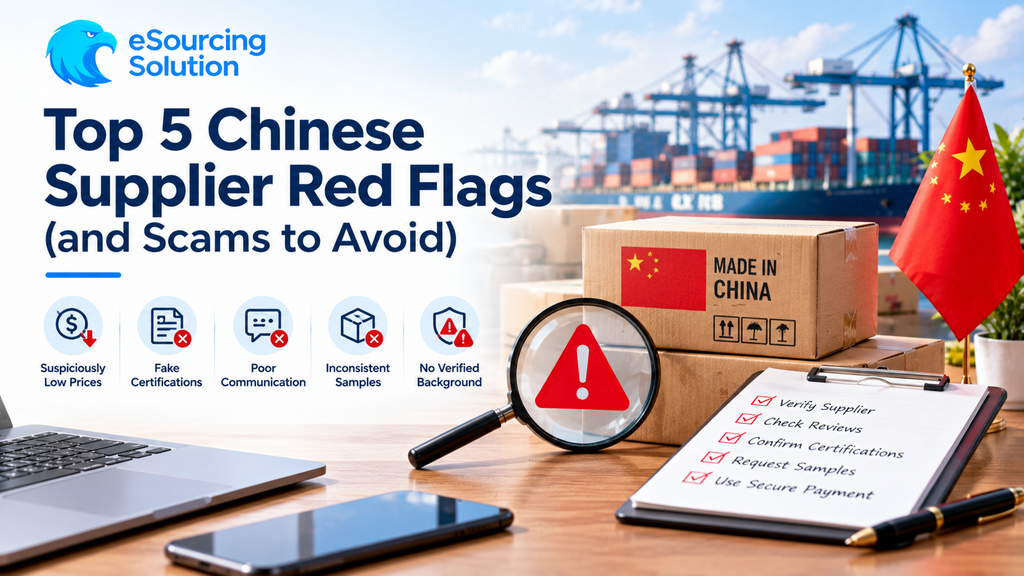
Table of Contents
Chinese Supplier Red Flags You Should Never Ignore
Not every warning sign means a supplier is dishonest. A new business may have limited export experience, and a genuine manufacturer may not have a polished website. What matters is whether the supplier can provide reasonable, verifiable answers to your questions.
Red Flag 1: The Supplier Refuses to Share Business Registration Details
A legitimate Chinese business should be able to provide its registered company name and business license. Mainland Chinese companies also have an 18-character Unified Social Credit Code, which helps identify the registered entity.
Ask for the supplier’s official Chinese company name, business license, registered address, and Unified Social Credit Code. You can then cross-check the details through China’s National Enterprise Credit Information Publicity System.
Check whether the company is active, whether the registration details match the documents you received, and whether its registered business scope is consistent with its claimed activities.
A company registered for trading may still be a suitable supplier. The concern is when it claims to own and operate a factory but cannot explain or prove that relationship.
Red Flag 2: The Price Is Much Lower Than Other Quotations
Competitive pricing is one reason businesses source from China. However, a quotation that is far below the others deserves closer attention.
A supplier might quote a low price to win the order and later demand additional payments. In other cases, the original price excludes important costs, such as tooling, packaging, inspection, or export handling. Some suppliers may also use cheaper materials or components to meet an unrealistic price.
Before accepting a quotation, compare at least three suppliers using the same product specifications.
Check:
- Material grade and product dimensions.
- Order quantity and minimum order quantity (MOQ).
- Packaging and labeling requirements.
- Tooling, mold, and customization charges.
- Shipping terms and other additional costs.
- Product testing and quality inspection requirements.
A lower quotation can be genuine if the supplier has better production efficiency or a different business model. The important thing is to understand exactly what you are paying for.
Read more on 8 Mistakes to Avoid When Hiring a Shenzhen Sourcing Agent
Red Flag 3: The Supplier Pressures You to Pay Immediately
Messages such as “This price is only available today” or “You must pay now to secure your production slot” can be designed to stop buyers from checking the details.
Urgency alone does not prove fraud. Factories may have genuine production schedules or changing material costs. However, a supplier should not object when you request time to verify its identity, review the contract, or arrange an inspection.
Do not allow a sales deadline to replace your normal purchasing process. If the supplier refuses basic checks because you need more time, consider finding another option.
Red Flag 4: The Supplier Cannot Prove Its Manufacturing Capabilities
Some suppliers are trading companies rather than manufacturers. There is nothing inherently wrong with working with a trading company, particularly if it offers product selection, communication, and quality control services.
The problem arises when a supplier misrepresents its role. Ask for a live video tour of the factory, photographs of relevant production equipment, details of the quality control process, and evidence of previous work in your product category.
You can also ask technical questions about materials, production tolerances, testing procedures, and expected lead times.
If the supplier claims to manufacture a wide range of unrelated products, investigate whether it operates multiple facilities or sources goods from other factories. A broad product range is a reason to ask questions, not automatic proof of a scam.
Red Flag 5: The Supplier Refuses a Third-Party Inspection
A supplier may tell you that its internal quality team is sufficient or that an inspection will delay shipment. However, buyers should not have to rely entirely on the supplier’s own assessment of the goods.
A pre-shipment inspection can help check product specifications, workmanship, quantity, packaging, labeling, and other agreed requirements before the goods leave the factory.
For a large order, refusing reasonable independent inspection access is a serious warning sign, particularly when combined with poor communication or unclear contract terms.
Agree on inspection criteria before production begins. This gives both parties a clear understanding of what the finished products must meet.
Common China Sourcing Scams and How They Work
Some scams involve completely fake businesses. Others involve real suppliers, compromised email accounts, or misleading documents. Knowing the common patterns helps buyers identify problems before money is lost.
| Scam type | How it works | How to reduce the risk |
| Fake supplier | A business creates a convincing profile but cannot deliver the goods | Verify registration and manufacturing capabilities |
| Payment diversion | Someone sends altered bank details or impersonates the supplier | Confirm changes using a previously verified phone number |
| Product substitution | The supplier sends lower-grade goods than agreed | Approve samples and define specifications in writing |
| Fake certificates | Documents are altered, expired, or unrelated to the product | Check certificates with the issuing organization |
| Sample scam | A good sample is supplied, but bulk production is poor | Arrange independent inspections during production and before shipment |
| Shipping or fee scam | Unexpected charges are demanded after payment | Agree on costs, shipping terms, and responsibilities in advance |
| Fake trading company | An intermediary misrepresents its relationship with the factory | Identify the legal seller and confirm the actual production arrangement |
Watch for Bank Account Changes
Payment diversion is particularly dangerous because the supplier relationship may be genuine.
For example, you may have worked with a factory for months when an email arrives explaining that its bank account has changed. The message may look almost identical to previous correspondence, but the new details belong to a fraudster.
The US Federal Bureau of Investigation warns businesses about business email compromise, including fraudulent requests to change payment information. Its business email compromise guidance recommends independently verifying unusual payment requests.
Always confirm new bank details by calling a contact using a number you already know is genuine. Do not rely on the telephone number or link contained in the suspicious email.
How to Verify a Chinese Supplier Before Paying
Supplier verification should happen before you commit to a large order, not after something goes wrong.
Check the Legal Company Information
Start with the official business license and registration details. Compare the legal company name on the license with the name on the quotation, contract, invoice, and proposed bank account.
If different companies appear on these documents, ask for an explanation and supporting documentation. A legitimate group may use separate entities for manufacturing, exporting, and receiving payments, but the relationship should be clear and documented.
Use the National Enterprise Credit Information Publicity System to check registration information where available. If you cannot confidently interpret the records, consider using a qualified verification service.
Verify the Factory and Its Experience
A video call can help establish whether the supplier has access to the facilities it claims to operate. Ask to see the production line, relevant equipment, storage areas, and quality control activities.
For higher-value orders, consider an independent factory audit. An auditor can assess the facility, production capacity, processes, and other areas relevant to the purchase.
Also ask for references from previous customers, preferably buyers with similar products or order volumes. References should be checked independently rather than accepted at face value.
Request Samples and Approve Specifications
Samples are useful, but they are only one part of supplier evaluation. A good sample does not guarantee that the bulk order will match it.
Prepare a written specification sheet that covers:
- Materials, dimensions, weight, and tolerances.
- Color, finish, and product performance.
- Packaging, labels, and barcodes.
- Required tests and applicable standards.
- Acceptable defect levels and inspection procedures.
Keep an approved reference sample where practical. Make sure the purchase agreement states what happens if the delivered goods fail to meet the agreed requirements.
Use a Written Contract and a Sensible Payment Structure
Your purchase agreement should identify the legal parties, product specifications, quantity, price, delivery date, shipping terms, inspection requirements, and procedures for handling defective or delayed goods.
For a first order, buyers often negotiate a deposit with the balance linked to an agreed milestone. The right structure depends on the product, supplier, order size, and transaction terms. There is no single payment split that is safe for every purchase.
Avoid sending the full order value upfront when you have not established the supplier’s reliability and have no meaningful protection in place.
Where available, platform payment protection may help. For example, Alibaba Trade Assurance ties protection to the online order terms and payments made through the platform. Read the current terms carefully and ensure product specifications and shipping dates are recorded correctly. Do not assume that an off-platform transfer receives the same protection.
Payment Red Flags: When You Should Stop the Transaction
Payment requests deserve special attention because recovering money sent across borders can be difficult.
Stop and investigate if a supplier:
- Asks you to pay an individual’s personal bank account without a clear, documented reason.
- Requests cryptocurrency, gift cards, or another unusual payment method for a normal commercial order.
- Changes bank details at the last minute.
- Requests an unexpected extra payment to release goods without supporting documentation.
- Pressures you to bypass an agreed platform or payment process.
- Refuses to explain who legally owns the receiving account.
A payment to a Hong Kong account is not automatically fraudulent, and some legitimate export businesses use overseas entities. However, the account holder must be identified, and the arrangement independently verified.
The safest approach is to make payments only after confirming the supplier’s legal identity, contractual responsibilities, and authorized payment details.
If you suspect payment fraud, contact your bank or payment provider immediately. Fast reporting may improve the chance of stopping or tracing a transfer, although recovery is never guaranteed.
How to Protect Your Business During Production and Shipping
Supplier checks should continue after the deposit is paid. Problems can develop during production even when the supplier was legitimate at the start.
- Monitor production progress. Agree on milestones and request reasonable updates, such as photographs, production reports, or video calls.
- Arrange quality inspections. Depending on the order, you may need a pre-production inspection, during-production inspection, or pre-shipment inspection. Select the checks according to the product’s risk and value.
- Confirm shipping documents. Review commercial invoices, packing lists, and other relevant export or transport documents. Make sure the quantities, descriptions, and parties match the order.
- Clarify shipping responsibilities. Agree on the applicable Incoterms, delivery point, freight arrangements, customs responsibilities, and insurance requirements where relevant.
- Keep records. Save quotations, contracts, approved samples, specifications, inspection reports, payment receipts, and important communications. These records may be important if a dispute occurs.
For businesses sourcing multiple products, a structured supplier management process makes it easier to compare vendors and identify problems before they affect the wider supply chain.
Quick Checklist: Is Your Chinese Supplier Safe to Work With?
Before approving a new supplier, use this checklist.
- The legal company name and business registration have been checked.
- The supplier’s role as a manufacturer or trading company is clear.
- The factory or production arrangement has been verified.
- Product samples meet the agreed requirements.
- Certifications have been checked with the relevant issuing body.
- The quotation includes the required product specifications and costs.
- The contract clearly identifies both parties and delivery obligations.
- Payment details have been independently verified.
- Quality inspection arrangements have been agreed.
- Shipping terms and documentation requirements are clear.
- The supplier accepts reasonable due diligence without excessive pressure.
If several items remain unchecked, delay the payment until you have addressed the gaps. If the supplier refuses basic identity checks or insists on an unexplained payment diversion, walking away may be the better business decision.
Final Thoughts
Choosing a Chinese supplier is not just about finding the lowest quotation. It is about finding a business that can deliver the right product, meet your quality requirements, communicate clearly, and honor its contractual commitments.
The most effective way to avoid scams is to verify the supplier before paying, compare quotations carefully, approve product specifications in writing, and arrange independent inspections when necessary. Keep payment details under control and never allow pressure to replace proper due diligence.
A little extra checking at the beginning can help prevent expensive delays, defective shipments, and financial losses later.
Need help finding and verifying reliable suppliers in China? Book a free consultation with us for support with supplier sourcing, verification, and quality control. Our team can help you approach China sourcing with a clearer process and make better-informed purchasing decisions.
Frequently Asked Questions
What is the biggest red flag when choosing a Chinese supplier?
An unexplained request to pay a personal or unrelated third-party account is one of the most serious warning signs. Refusal to provide verifiable registration details is another. Either should trigger further checks before you proceed.
Are Chinese suppliers on Alibaba trustworthy?
Some are reliable, while others may be unsuitable or fraudulent. Platform badges and verification services can provide useful information, but they do not replace independent checks of the legal entity, product quality, contract, and payment details.
How can I check whether a Chinese manufacturer is real?
Request its business license and Unified Social Credit Code, check its registration through China’s official enterprise information system, and compare its claimed activities with the records. For larger orders, consider a factory audit and independent product inspection.
Should I pay a Chinese supplier 100% upfront?
Full upfront payment can expose you to substantial risk, especially when dealing with a new supplier. Negotiate a payment structure that reflects the transaction, your verification results, and available safeguards. For high-value orders, seek professional advice on contract and payment terms.
What should I do if a Chinese supplier scams me?
Contact your bank or payment provider immediately, preserve all communications and transaction records, notify the sourcing platform if applicable, and consider reporting the incident to relevant authorities. A lawyer experienced in cross-border commercial disputes can advise you on possible recovery options.